
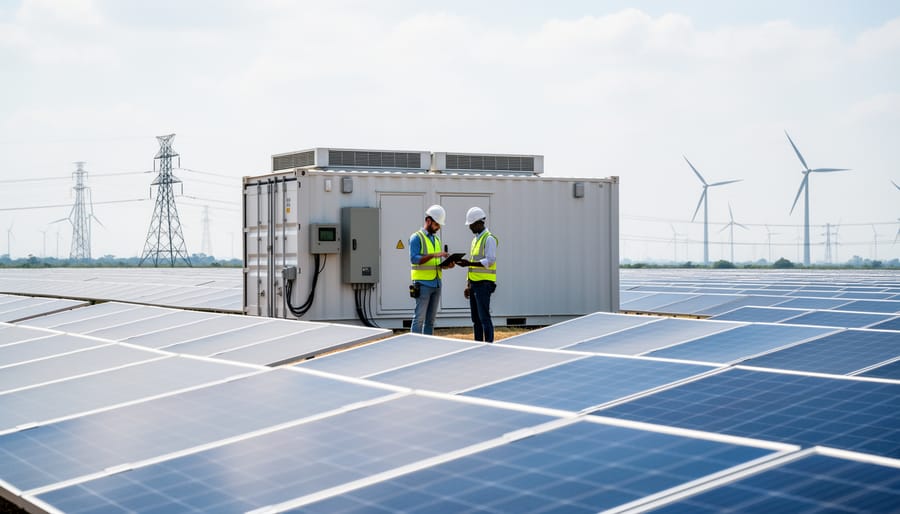
Solar international energy collaboration has evolved from bilateral research agreements into a sophisticated ecosystem of multilateral financing vehicles, technology transfer protocols, and harmonized standards that now move billions of dollars and gigawatts of capacity across borders annually. What began in the 1970s as modest knowledge-sharing between national laboratories has matured into complex public-private partnerships involving development banks, sovereign wealth funds, equipment manufacturers, and grid operators working across continents to deploy solar infrastructure at unprecedented scale.
The mechanics of these collaborations reflect both technical necessity and geopolitical strategy. Solar projects in emerging markets increasingly depend on blended finance structures where concessional loans from institutions like the World Bank or Asian Development Bank de-risk investments for commercial lenders, while technology providers from Europe, Asia, and North America compete to set de facto standards through their equipment choices. Cross-border power purchase agreements now connect solar farms in Morocco to European grids, and Chinese panel manufacturers have established production facilities from Vietnam to Mexico to navigate trade barriers while serving regional markets.
Yet the landscape grows more complex. Supply chain vulnerabilities exposed during recent disruptions have prompted calls for diversified manufacturing, while concerns over embedded carbon in imported components and labor practices are reshaping procurement criteria. Simultaneously, emerging technologies like perovskite tandem cells and advanced storage systems require new forms of collaborative research that transcend traditional north-south or bilateral frameworks. The partnerships advancing solar deployment today must balance commercial imperatives, energy security considerations, climate commitments, and evolving technical standards across jurisdictions with divergent regulatory philosophies and political priorities.
Understanding these dynamics matters for anyone shaping or responding to the global solar buildout through 2030 and beyond.
The Architecture of Modern Solar Energy Cooperation

Multilateral Frameworks and Treaty Organizations
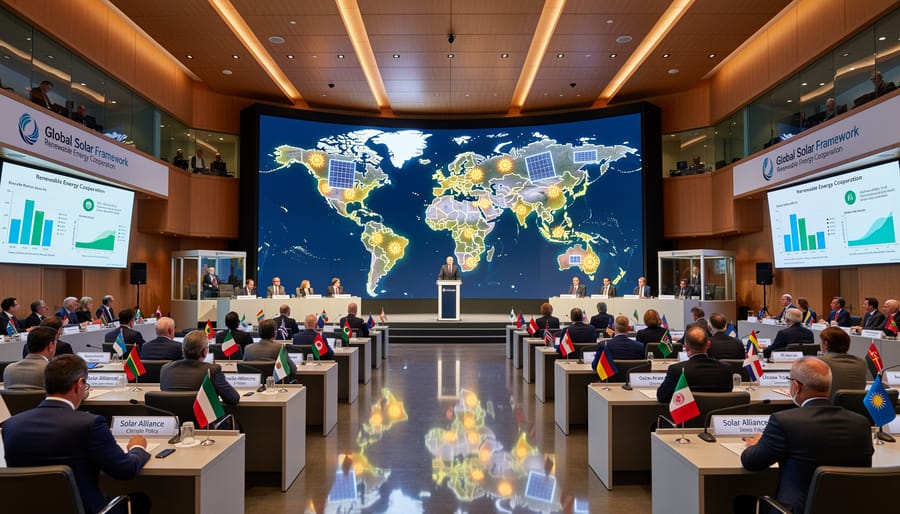
The institutional architecture supporting global solar cooperation rests on several distinct models, each designed to address specific barriers in technology deployment and market development. The International Solar Alliance (ISA), launched in 2015 and headquartered in India, now counts 116 signatory nations committed to mobilizing more than $1 trillion in solar investment by 2030. Unlike traditional treaty organizations, the ISA framework agreement establishes a cooperative platform rather than binding emission targets, focusing instead on aggregating demand, reducing technology costs through collective procurement, and establishing common technical standards for solar systems in tropical and sub-tropical regions.
The IEA Photovoltaic Power Systems Programme (IEA-PVPS), operating since 1993 under the International Energy Agency, takes a fundamentally different approach. With 36 participating countries representing approximately 90% of global installed capacity, it functions as a knowledge-sharing network rather than a financing mechanism. Member nations contribute technical expertise through collaborative research tasks examining grid integration challenges, performance standards, and emerging applications. The IEA PVPS country updates document how this research translates into national policy frameworks and deployment strategies across diverse markets.
Regional bodies fill critical gaps left by global institutions. The ASEAN Centre for Energy coordinates solar standards harmonization across Southeast Asia, while the African Union’s Programme for Infrastructure Development in Africa (PIDA) prioritizes cross-border transmission enabling continental-scale solar deployment. These regional frameworks address technical interoperability and regulatory alignment that bilateral agreements cannot efficiently resolve, creating the connective tissue between national ambitions and transnational infrastructure reality.
Bilateral Technology and Finance Partnerships
Bilateral partnerships between developed and emerging economies have become increasingly important mechanisms for solar deployment, combining targeted financial support with hands-on technical collaboration. Unlike broad multilateral frameworks, these direct country-to-country arrangements allow for customized approaches that address specific infrastructure gaps, regulatory challenges, and local market conditions.
Germany’s partnership with India exemplifies this model. Through the Indo-German Energy Programme, German development bank KfW has channeled over €1 billion into Indian solar projects since 2015, while technical agencies provide grid integration expertise and workforce training. The arrangement addresses both sides’ interests: India gains access to below-market financing and proven technology standards, while German manufacturers and engineering firms secure market presence in a rapidly expanding sector.
Japan has pursued similar bilateral structures across Southeast Asia, with the Japan International Cooperation Agency (JICA) providing concessional loans tied to technology transfer requirements. In Vietnam, this approach supported 2.4 GW of solar capacity additions between 2019 and 2021, with Japanese firms establishing local assembly operations and training Vietnamese engineers in O&M practices.
These partnerships typically combine three elements: development finance at favorable rates, technical assistance covering everything from feasibility studies to grid code development, and capacity-building programs that create sustainable local expertise. The financial instruments range from direct sovereign loans to blended structures mixing concessional and commercial terms, with repayment often linked to project revenues rather than fixed schedules.
Case Studies: Solar Collaborations Delivering Results
Africa-Europe Solar Corridors
North Africa’s exceptional solar irradiance, exceeding 2,800 kWh/m² annually in locations like Morocco’s Ouarzazate, has long attracted European attention as a complementary renewable resource to supplement the continent’s own generation capacity. Projects like Morocco’s 580 MW Noor Complex, initially conceived with European export ambitions, demonstrated the technical feasibility of large-scale concentrated solar power in the Maghreb region. Yet realising true cross-Mediterranean energy corridors requires more than generation infrastructure; it demands high-voltage subsea transmission links capable of moving gigawatt-scale solar electricity northward.
The GREGY electrical interconnection exemplifies this approach, planning to link Greece, Egypt, and potentially Cyprus through subsea cables carrying renewable power, including Egyptian solar output, into European markets. Similar concepts have targeted Tunisia-Italy and Morocco-Spain connections, though progress has been uneven, financing complexity, regulatory misalignment between European and North African grid codes, and shifting political priorities have slowed implementation.
When operational, these corridors could transform bilateral energy relationships: North African nations gain hard currency and industrial development anchors, while European utilities access dispatchable solar generation that complements their own variable renewables. The partnerships require sophisticated joint venture structures balancing sovereign interests, private capital deployment, and technical coordination across multiple time zones and regulatory regimes, illustrating how solar international energy collaborations extend far beyond equipment procurement into deep infrastructure integration.
Asia-Pacific Technology Transfer Programs
China, Japan, and South Korea have transformed Southeast Asia and the Pacific into testing grounds for complementary approaches to solar technology transfer. China’s Belt and Road Initiative has financed manufacturing facilities across Vietnam, Thailand, and Indonesia, creating regional production networks that reduce shipping costs while building local expertise in cell assembly and module production. These partnerships typically bundle equipment supply with training programs, establishing technical workforces capable of operating and maintaining gigawatt-scale facilities.
Japan’s approach prioritizes high-efficiency technology deployment in island nations facing severe land constraints. Through bilateral agreements with the Philippines, Fiji, and Papua New Guinea, Japanese corporations provide bifacial panels and concentrated photovoltaic systems alongside detailed performance monitoring. The partnerships include multi-year technical support contracts, ensuring recipient nations develop troubleshooting capabilities rather than remaining dependent on external expertise.
South Korea occupies a middle position, focusing on Bangladesh, Cambodia, and Laos with integrated manufacturing and deployment programs. Korean firms establish joint-venture production lines manufacturing panels specifically designed for tropical humidity and typhoon conditions, whilst simultaneously developing utility-scale projects that serve as demonstration sites. This model creates immediate domestic markets for locally-produced equipment, accelerating both manufacturing maturity and installation experience.
The region now hosts 18% of global solar manufacturing capacity, up from 4% in 2020, directly attributable to these structured technology transfer programs that combine capital investment with deliberate skills development.
Americas Regional Integration Projects
The Americas have witnessed increasingly sophisticated solar energy cooperation frameworks that leverage the continent’s diverse geography and complementary resource profiles. Chile’s Atacama Desert and Mexico’s northern regions supply some of the world’s highest solar irradiance levels, while Brazil’s hydroelectric dominance creates natural synergies for hybrid renewable systems spanning multiple nations.
Cross-border transmission projects like the Mesoamerican Electrical Interconnection System now enable six Central American nations to share solar generation alongside other renewables, creating a regional grid that balances seasonal variations and time-zone differences. This 230-kilovolt network has reduced generation costs across participating countries while improving supply reliability during drought periods that historically challenged hydropower-dependent systems.
The Pacific Alliance nations (Chile, Colombia, Mexico, and Peru) established joint research programs focused explicitly on solar-plus-storage configurations suitable for desert and tropical climates. Their collaborative testing facilities evaluate battery chemistries and inverter technologies under extreme temperature ranges, sharing performance data that accelerates commercial deployment throughout the region.
North American cooperation extends beyond NAFTA-era frameworks, with the United States, Mexico, and Canada coordinating solar manufacturing supply chains and equipment standards that facilitate cross-border project development. Recent initiatives target solar component production diversification, reducing dependence on single-source suppliers while building regional manufacturing expertise.
These partnerships demonstrate how geographic complementarity and shared technical challenges drive meaningful collaboration across vastly different economic contexts.
Technology Transfer and Intellectual Property Challenges
The tension between protecting innovation and democratizing access to solar technology represents one of the most delicate challenges in international renewable energy collaboration. Companies and research institutions that invest millions in developing advanced photovoltaic materials, manufacturing processes, or system optimization algorithms understandably seek to recoup their investments through patent protection and licensing fees. Yet the urgency of climate action and energy access demands rapid, widespread deployment of proven technologies, particularly in emerging markets where cost barriers remain significant.
This fundamental conflict has shaped how international solar partnerships approach intellectual property. Rather than treating IP as an absolute barrier, successful collaborations have developed nuanced frameworks that acknowledge both innovation incentives and deployment imperatives. The patent landscape in solar technology is dense and fragmented, with thousands of patents covering everything from silicon purification methods to inverter control algorithms, creating potential roadblocks when multiple technologies must integrate in a single project.
Several licensing models have emerged to navigate these waters. Non-exclusive licensing arrangements allow multiple manufacturers across different regions to produce solar components using patented technologies, expanding production capacity without creating territorial monopolies. Some technology leaders have adopted voluntary licensing commitments for certain foundational patents, particularly those related to basic cell architectures now considered industry standards. Patent pools, where multiple patent holders contribute their IP to a common repository accessible under unified licensing terms, have proven particularly valuable in addressing the “patent thicket” problem that can stall cross-border projects requiring dozens of discrete technologies.
Capacity-building programs represent another crucial mechanism balancing IP protection with technology diffusion. Rather than simply licensing patents, these partnerships transfer underlying knowledge through technical training, joint research initiatives, and collaborative manufacturing arrangements. China’s establishment of solar manufacturing hubs across Southeast Asia and Africa exemplifies this approach, combining equipment provision with sustained training programs that build local expertise. Similarly, European photovoltaic research institutes have developed partnerships with universities in Latin America and South Asia that focus on adaptation engineering, modifying existing technologies for local climate conditions, grid characteristics, and manufacturing capabilities whilst respecting the original IP frameworks.
The challenge intensifies when collaborations involve not just hardware but also operational software, artificial intelligence algorithms for grid management, and proprietary system optimization tools increasingly central to modern solar installations. These digital elements require ongoing updates and support, creating dependencies that traditional one-time technology transfers cannot address. Forward-looking partnerships are therefore establishing long-term technical support arrangements and knowledge-sharing protocols that extend beyond initial project commissioning.
Financial Mechanisms Enabling Cross-Border Solar Investment
Concessional Finance and Development Aid
Concessional finance channels billions of dollars into solar projects that commercial lenders consider too risky or unprofitable. Multilateral development banks structure these instruments with extended repayment periods, often 20 to 40 years, and interest rates substantially below market, sometimes as low as 0.75 percent. The World Bank’s IDA window has committed over $3 billion to solar energy access since 2020, prioritizing grid extension and distributed generation in sub-Saharan Africa where connection rates lag behind population growth.
The Asian Development Bank employs a different model, blending concessional loans with technical assistance grants that build procurement capacity and regulatory frameworks alongside the infrastructure itself. Their solar programs in Bangladesh and the Philippines pair hardware financing with parallel investments in metering systems and utility training, addressing bottlenecks that stall projects even when capital is available.
Bilateral aid programs add targeted flexibility. Germany’s KfW and Norway’s Norfund structure country-specific facilities responding to local constraints, currency risk in one market, land tenure uncertainty in another. These programs accept lower returns than commercial investors require, effectively subsidizing the risk premium that would otherwise price developing nations out of utility-scale solar deployment. The trade-off is explicit: patient capital in exchange for measurable development outcomes and climate mitigation verified through third-party monitoring.
Commercial Investment and Risk Mitigation
Commercial capital has become the dominant financing force in international solar energy projects, with private investment flows now exceeding $200 billion annually. Unlike concessional finance, commercial investors demand market-rate returns and require sophisticated risk mitigation tools to deploy capital across borders where political uncertainty, currency volatility, and regulatory unpredictability create investment barriers.
Political risk insurance from providers like MIGA (Multilateral Investment Guarantee Agency) and private insurers covers expropriation, currency inconvertibility, war, and breach of contract. These guarantees typically protect 90% of equity investments and debt obligations for up to 20 years, making large-scale solar projects in frontier markets commercially viable. A 300MW solar installation in Sub-Saharan Africa might secure $180 million in political risk coverage, transforming an otherwise unbankable project into an attractive institutional investment.
Currency hedging addresses the revenue-cost mismatch common in cross-border solar finance. Projects generating local-currency revenue while servicing hard-currency debt face devastating exchange rate exposure. Forward contracts, currency swaps, and local-currency bonds issued by development finance institutions provide hedging mechanisms. A Brazilian solar developer might use currency derivatives to lock in real-dollar exchange rates over a 15-year power purchase agreement, eliminating foreign exchange risk that would otherwise price the project out of commercial markets.
Commercial lenders increasingly rely on partial credit guarantees from institutions like IFC or national export credit agencies. These instruments cover the first-loss position on debt, typically 30-50%, reducing perceived risk sufficiently for pension funds and infrastructure investors to participate at scale.
Standardization and Grid Integration Across Borders
Technical interoperability represents the unglamorous foundation upon which ambitious cross-border solar projects either succeed or stumble. While financing and policy frameworks attract attention, the practical challenges of connecting disparate electrical systems and ensuring equipment compatibility determine whether electrons actually flow across borders. The International Electrotechnical Commission’s PV standards (IEC 61215, 61730) have created baseline equipment safety and performance criteria, yet their adoption remains uneven across markets. When Morocco’s Noor solar complex exports power to Spain via the Morocco-Spain interconnection, voltage and frequency synchronization become critical operational concerns rather than abstract engineering concepts.
Grid code harmonization presents perhaps the most complex technical coordination challenge. Each nation’s electrical system evolved independently with unique voltage levels, frequency tolerances, fault ride-through requirements, and reactive power specifications. The European Network of Transmission System Operators for Electricity (ENTSO-E) has invested two decades developing common grid codes that enable renewable integration across 35 countries, establishing technical requirements for everything from inverter response times to voltage quality during disturbances. Their experience demonstrates that harmonization is not a one-time exercise but an ongoing process as solar penetration levels increase and storage systems add new variables.
Cross-border electricity trading requires sophisticated balancing mechanisms that account for solar’s variable output. The Southern African Power Pool operates real-time markets where South Africa’s solar generation can meet Namibian demand spikes, but only because participating utilities agreed on common metering standards, settlement procedures, and data exchange protocols. Similar coordination enables the Nordic countries to balance hydropower with solar imports from continental Europe. Without standardized communication protocols like IEC 61850 for substation automation, these transactions would require manual coordination incompatible with the subsecond response times modern grids demand. The technical groundwork, unglamorous but essential, determines whether international solar partnerships remain conceptual or deliver measurable energy flows across borders.
Geopolitical Dimensions of Solar Energy Partnerships
International solar collaborations unfold against a backdrop of shifting geopolitical alliances and strategic competition. Energy security concerns increasingly drive nations to diversify supply sources and reduce dependence on fossil fuel imports from politically unstable regions. Solar partnerships offer governments a pathway to domestic energy autonomy while simultaneously forging diplomatic ties, a dual objective that shapes project selection and financing arrangements far beyond technical or economic considerations alone.
China’s Belt and Road Initiative illustrates how renewable energy infrastructure serves strategic purposes. By financing solar installations across Africa, Southeast Asia, and Central Europe, Beijing secures diplomatic goodwill, creates markets for Chinese manufacturers, and positions itself as the enabler of energy transitions in developing economies. Western nations have responded with competing frameworks like the EU’s Global Gateway and the G7’s Partnership for Global Infrastructure and Investment, explicitly positioning solar energy cooperation as a counterweight to Chinese influence in emerging markets.
Supply chain concentration creates vulnerability that shapes collaboration strategies. When over 80 percent of polysilicon production and 97 percent of solar wafer manufacturing resides in one country, governments recognize the security risks inherent in technological dependence. This reality drives initiatives to establish parallel manufacturing capabilities through regional partnerships, Europe’s Solar PV Industry Alliance and the U.S.-India Critical and Emerging Technology framework both aim to diversify component sourcing while maintaining technological leadership.
Trade disputes routinely disrupt cooperative frameworks. Antidumping tariffs, local content requirements, and export restrictions on critical minerals fragment what might otherwise function as a seamless global market. Countries balancing economic efficiency against strategic autonomy face genuine dilemmas: procuring the cheapest solar equipment may strengthen a geopolitical rival, while supporting domestic manufacturing raises project costs and slows deployment.
Solar partnerships also function as soft power instruments. Nations providing technical assistance and concessional financing to support solar adoption in developing countries gain influence over energy sector governance, regulatory frameworks, and future procurement decisions. Japan’s technical cooperation programs across Southeast Asia, Germany’s renewable energy partnerships in North Africa, and the UAE’s investments in African solar projects all reflect this strategic dimension, where development assistance intersects with longer-term economic and political positioning.

Emerging Trends Shaping Future Collaborations
International solar energy collaborations are entering a phase defined by convergence, where solar deployment intersects with hydrogen economies, digital infrastructure, and climate resilience in ways that demand new partnership models.
Green hydrogen production alliances represent the most capital-intensive frontier. Countries with exceptional solar resources are partnering with industrial nations to build dedicated solar farms feeding electrolysis plants, creating exportable energy carriers. Australia’s agreements with Japan and South Korea exemplify this shift, with planned facilities in Western Australia’s Pilbara region targeting 2028 commissioning dates for multi-gigawatt solar-to-hydrogen operations. These partnerships extend beyond electricity generation into shipping logistics, storage technology development, and end-use industrial integration.
Manufacturing diversification efforts are reshaping supply chain geography. The concentration of solar module production in a handful of regions has prompted strategic alliances to establish regional manufacturing capacity. India’s collaboration with European equipment suppliers to build polysilicon and wafer facilities demonstrates how technology transfer now emphasizes complete value chain development rather than final assembly alone. These partnerships increasingly include recycling infrastructure planning from the outset, anticipating the material recovery demands as early installations reach end-of-life.
Climate adaptation projects are driving partnerships in regions where solar deployment must account for extreme weather resilience. Cyclone-resistant mounting systems developed through Pacific island collaborations with engineering institutions in Australia and New Zealand now inform design standards for coastal installations globally. Similarly, solar-powered desalination projects in Middle Eastern partnerships with Mediterranean nations are creating dual-purpose infrastructure addressing both energy access and water security.
Artificial intelligence integration in cross-border grid management enables coordination previously impossible with conventional systems. Nordic-Baltic grid operators working with machine learning specialists are developing forecasting models that predict solar generation across multiple time zones and weather systems, optimizing transmission capacity allocation in real time. These digital collaboration frameworks are becoming prerequisites for the high renewable penetration levels targeted in interconnected grid regions.
The emerging pattern shows partnerships evolving from project-specific agreements toward integrated platforms addressing interconnected challenges, energy, water, industrial development, and climate resilience, with solar as the enabling technology rather than the isolated focus.
The trajectory of solar international energy collaborations has shifted from aspirational frameworks to operational necessities driving measurable progress toward climate commitments. These partnerships have demonstrated that accelerating solar deployment at the scale required to meet 2030 targets depends on coordinated action that transcends national boundaries and sectoral silos.
Successful collaborations consistently balance three interdependent elements: technical standardization that enables interoperability, financial mechanisms that mobilize capital across risk profiles, and political frameworks that align policy environments while respecting sovereignty. Projects falter when one dimension overshadows the others, when technology transfer occurs without sustainable financing, or when funding flows to markets lacking regulatory stability.
The evolution from isolated pilot projects to integrated regional systems reflects growing recognition that solar energy infrastructure increasingly functions as shared international assets. Cross-border transmission corridors, multinational manufacturing ecosystems, and joint research initiatives have created dependencies that make cooperation pragmatic rather than merely idealistic. Countries that position themselves as reliable partners in these networks gain advantages in technology access, investment flows, and grid resilience.
What distinguishes current collaborations from earlier efforts is their focus on tangible deployment outcomes rather than process alone. The most effective partnerships establish clear capacity targets, transparent progress metrics, and mechanisms for adapting to technical or market shifts. This results-oriented approach has accelerated installation rates while building expertise in emerging markets.
Since 1947, this publication has tracked energy developments across five continents, witnessing how international cooperation shapes infrastructure evolution. Solar partnerships now represent the leading edge of that transformation, proving that global energy transitions advance through practical collaboration grounded in mutual benefit and shared accountability.