
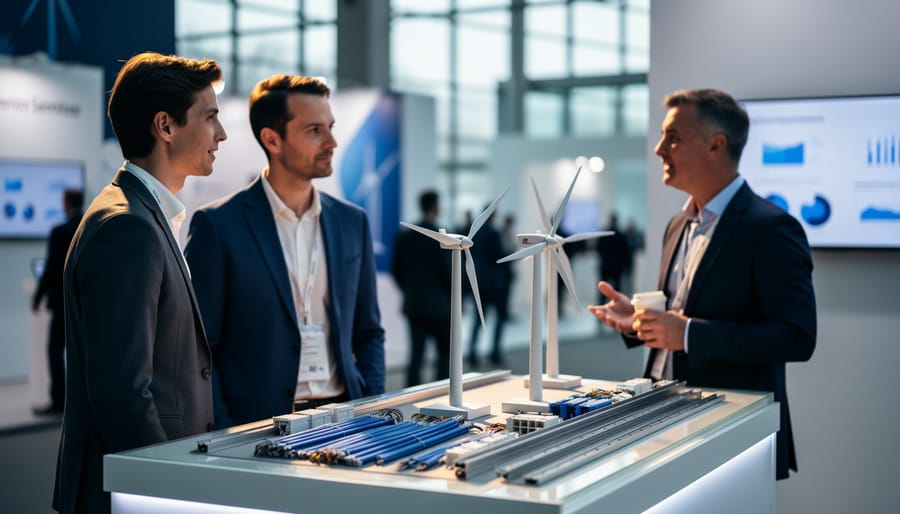
“Conference wind” refers to the knowledge, insights, and connections gained through informal conversations that occur in the margins of wind energy conferences, the hallway discussions, booth exchanges, and networking sessions that often prove more valuable than the formal presentations themselves. For professionals attending events like WindEnergy Hamburg, AWEA’s Clean Power conference, or regional gatherings in 2026, these unscripted moments drive deal-making, problem-solving, and international collaboration in ways that scripted panels rarely achieve.
The term originated within the wind industry to describe the phenomenon every veteran attendee recognizes: you learn what’s actually happening in offshore development over coffee, not from the keynote. A procurement manager discovers a new O&M solution provider while waiting for the lunch buffet. Two engineers compare notes on blade coating performance between sessions and solve a problem that’s been plaguing both their projects for months.
This informal knowledge transfer has grown increasingly critical as the wind sector matures and specializes. With offshore installations pushing into deeper waters, hybrid renewable systems becoming standard, and supply chain pressures reshaping procurement strategies, the complexity of modern wind development demands real-time, nuanced exchanges that formal presentations can’t accommodate. A 20-minute panel slot doesn’t leave room for the follow-up questions, the “here’s what we actually tried,” or the introductions that lead to partnerships.
Yet conference wind remains underutilized. Many attendees treat these gatherings as passive information sessions rather than active networking opportunities. Understanding how to identify, initiate, and maximize these informal exchanges separates professionals who extract real value from conference attendance from those who simply collect tote bags and business cards.
Defining Conference Wind: The Unstructured Power of Industry Gatherings
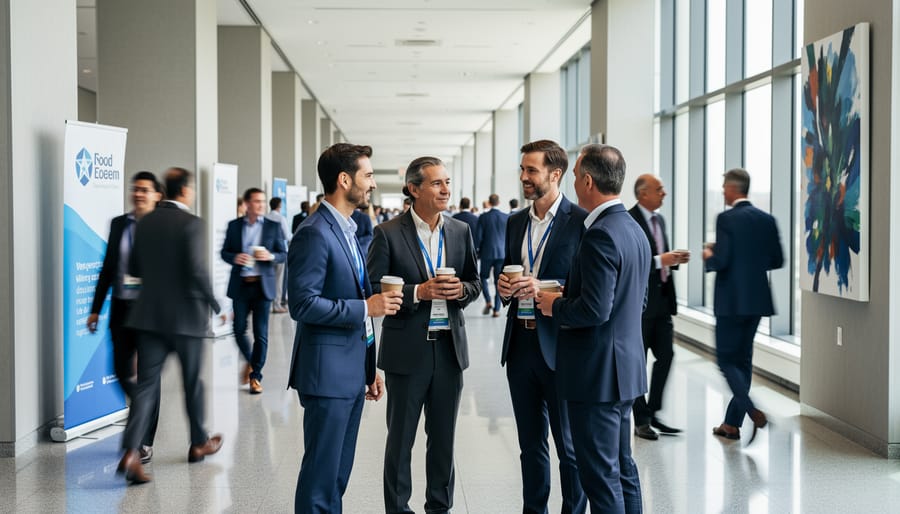
In the wind energy sector, “conference wind” refers to the organic, unscripted exchanges that happen when professionals step away from their seats. It’s the conversation that starts while reaching for the same coffee carafe, the impromptu troubleshooting session sketched on a napkin during lunch, or the breakthrough insight shared during a walk between venue buildings. Unlike the polished presentations delivered from podiums, conference wind blows through the margins of scheduled programming, carrying knowledge that rarely makes it into slide decks or conference proceedings.
This phenomenon has parallels across industries. Technology professionals speak of “hallway track” at developer conferences, those unstructured moments that often prove more valuable than keynote addresses. Medical conferences have their “corridor consultations” where clinicians discuss difficult cases away from formal CME sessions. In wind energy, the concept takes on particular significance because so much critical knowledge lives in the hands-on experience of operators, developers, and engineers rather than in published research.
Wind professionals value these informal interactions because they expose the messy reality behind successful projects. A formal session might present a case study of efficient turbine deployment. Conference wind reveals that the project nearly failed due to a specific blade transport issue on narrow European roads, and here’s exactly how the logistics team solved it. One conversation surfaces the supplier who actually delivers on time in Southeast Asian markets. Another provides the real reason why a particular financing structure worked in Texas but wouldn’t fly in Minnesota.
The spontaneity matters because people let their guard down. Marketing polish disappears. The engineer who presents a success story at 10 AM might, over afternoon drinks, candidly discuss the three approaches that failed first. The developer who formally praises a technology vendor might quietly warn you about their after-sales support gaps when nobody’s recording. These unvarnished exchanges, this conference wind, carry the texture and nuance that formal knowledge transfer systems filter out, making them indispensable for professionals navigating real-world challenges in renewable energy deployment.
How Conference Wind Differs From Formal Knowledge Transfer
Formal conference sessions follow a predictable arc. Speakers present curated success stories, highlight achievements, and showcase technologies that performed as expected. Questions from the audience remain polite, time-constrained, and rarely challenge core assumptions. The PowerPoint slides are polished, the data carefully selected, and the narrative constructed to reflect well on the presenting organization.
Conference wind operates under entirely different rules. In a hallway conversation between turbine engineers, the discussion centers on what went wrong with a blade design, not the marketing brochure version of its performance. Over drinks, a project developer admits that their most recent wind farm took eighteen months longer than planned because of unexpected bat migration patterns that regulators discovered mid-construction. These are the conversations where professionals drop the corporate veneer and discuss the messy realities of wind energy deployment.
The value gap between these two modes of knowledge transfer becomes clear when comparing their characteristics:
| Dimension | Formal Sessions | Conference Wind |
|---|---|---|
| Format | Scheduled, one-to-many, time-limited | Spontaneous, peer-to-peer, open-ended |
| Typical Content | Completed projects, validated data, success stories | Current challenges, failures, workarounds, honest assessments |
| Barriers to Honesty | Corporate approval, public record, competitive sensitivity | Low – off-the-record, relationship-based trust |
| Actionability | Conceptual frameworks, academic findings | Specific vendor performance, regulatory strategies, hiring referrals |
| Networking Value | Limited to Q&A exchanges | Relationship building, future collaboration opportunities |
The willingness to discuss failure distinguishes conference wind from stage presentations. No company schedules a session titled “Why Our Turbine Control System Failed in Extreme Temperatures.” Yet that exact conversation happens regularly at conference bars, where engineers compare notes on cold-weather performance issues and share the modifications that actually worked versus those recommended in technical manuals.
This candor serves a practical function. When an operations manager learns through informal conversation that three other wind farms experienced the same gearbox degradation pattern with a specific supplier, that intelligence informs purchasing decisions worth millions of dollars. The formal conference proceedings might eventually publish a study on gearbox reliability, but by then the manager has already locked into a five-year supply contract.
The unscripted nature of conference wind also permits real-time problem solving. A casual mention of permitting difficulties in a particular jurisdiction can prompt another attendee to share the specific environmental consultant who helped them navigate identical regulations. These exchanges happen too quickly and contextually to fit into a thirty-minute presentation slot, yet they represent exactly the type of actionable knowledge that professionals travel to conferences to obtain.
Where Conference Wind Happens: The Geography of Informal Exchange
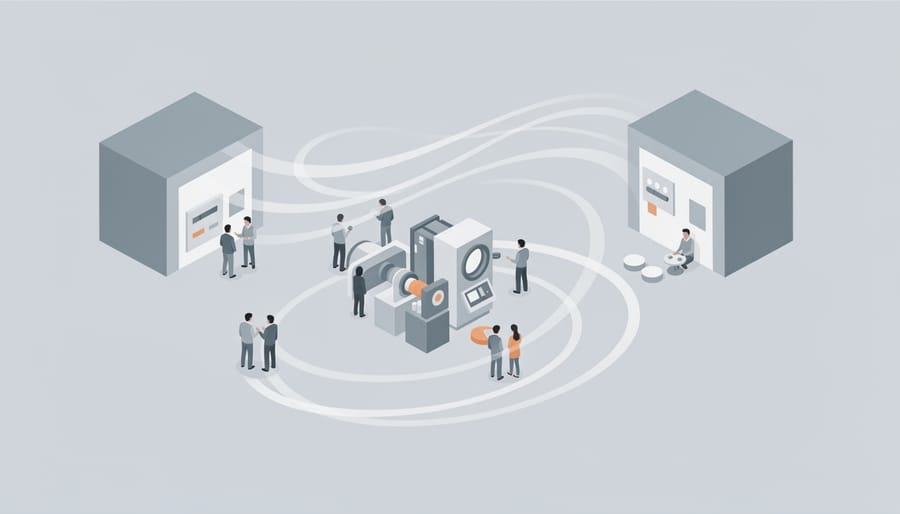
The most valuable conversations at wind energy conferences rarely happen in lecture halls. They emerge in transition zones, those interstitial spaces between scheduled events where professionals linger, reconnect, and exchange unfiltered insights.
Exhibition halls generate perhaps the densest concentration of conference wind. Unlike formal sessions where attendees sit passively, exhibition spaces encourage movement and chance encounters. A turbine manufacturer’s booth becomes a gathering point for discussing blade erosion patterns observed across different climatic zones. Competitors chat candidly near coffee stations about supply chain disruptions affecting nacelle delivery times. The exhibition floor’s open layout and longer duration create natural collision points where diverse perspectives intersect.
Coffee breaks deserve their reputation as knowledge transfer goldmines. These scheduled pauses offer just enough time for focused conversations without the social commitment of a full meal. Engineers cluster around pastry tables, sketching wind farm layouts on napkins. Two fifteen-minute breaks can yield more actionable intelligence than six hours of presentations, precisely because participants have just absorbed new information they’re eager to discuss or challenge.
Evening receptions and dinners extend the day’s momentum into more relaxed territory. Alcohol loosens tongues, and the absence of time pressure allows deeper exploration of complex topics. A developer might spend forty minutes describing permitting strategies that worked in offshore projects, knowledge they’d never formalize in a presentation but willingly share over drinks.
Transit spaces, shuttle buses between venues, hotel lobbies, even elevator rides, create captive audiences receptive to spontaneous dialogue. These brief interactions often plant seeds for later conversations or reveal unexpected common ground between strangers.
Conference organizers increasingly recognize their role as architects of serendipity. Strategic choices amplify conference wind: designating charging stations that keep people in shared spaces rather than scattered; extending break times from ten to twenty minutes; arranging open seating at lunches instead of assigned tables; hosting pre-conference site visits where small groups bond through shared experience.
The most sophisticated events now map participant flow, identifying bottlenecks and dead zones, then repositioning refreshments or attractions to encourage lingering in high-potential areas. They understand that their real product isn’t just the scheduled agenda but the conversations they facilitate around its edges.
The Knowledge That Travels on Conference Wind
Technical Troubleshooting and Real-World Solutions

At wind energy conferences, the exhibition floor and coffee stations become impromptu engineering clinics where turbine technicians and project engineers swap solutions to problems that never appear in official maintenance manuals. A conversation about bearing temperature anomalies might reveal that three other operators noticed the same pattern in a specific turbine model, along with the workaround they developed before the manufacturer issued a bulletin.
These exchanges fill critical knowledge gaps. When a utility-scale project experiences unexplained production curtailments, the formal support channels often provide generic troubleshooting steps. Conference wind offers something different: an engineer from another continent describing how they traced similar losses to a firmware interaction with a particular SCADA configuration, complete with the exact parameter adjustments that resolved it.
Grid integration challenges particularly benefit from this informal knowledge transfer. An engineer struggling with power quality issues during voltage fluctuations might learn during a hallway conversation that several projects in similar grid environments solved the problem by recalibrating their reactive power controllers beyond the settings recommended in the standard commissioning documentation. The engineer sharing this information has no commercial motive and nothing to gain except the satisfaction of helping a peer avoid weeks of troubleshooting.
The value lies in the specificity and honesty. These conversations acknowledge that turbines behave unpredictably, that O&M procedures require constant adaptation, and that real-world performance rarely matches the idealized scenarios in technical papers.
Market Intelligence and Project Development Insights
Beyond technical shop talk, conference wind carries intelligence that shapes multimillion-dollar decisions. A developer sharing coffee might casually mention that a particular county’s planning department now requires bird migration studies two years in advance, knowledge that could prevent costly project delays. These aren’t insights you’ll find in published market reports.
Land acquisition conversations reveal which regions have landowner fatigue from aggressive leasing practices, where community opposition has hardened, and which local law firms understand agricultural easements. One developer’s painful lesson about mineral rights conflicts becomes preventative knowledge for others. The project development insights exchanged in hallway conversations often prove more actionable than conference presentations because they’re unfiltered and current.
Supply chain realities emerge through these informal channels months before they appear in industry analyses. Equipment delivery timelines, which manufacturers are consistently meeting commitments versus which are overselling capacity, component quality issues discovered during commissioning, this intelligence flows peer-to-peer at conferences. Financial conversations matter equally: which lenders are actively seeking wind deals, what debt-to-equity ratios are actually closing, how tax equity appetite has shifted for specific turbine configurations.
This commercial knowledge rarely makes it into formal sessions because it’s commercially sensitive, region-specific, or involves admitting mistakes. Yet it fundamentally shapes where and how the next generation of projects gets built.
Conference Wind in the International Context: Bridging Global Markets

Conference wind operates on a fundamentally different scale at international gatherings, where the hallway conversations bridge not just companies but entire market ecosystems. A project developer from Germany discussing blade transport logistics with a Brazilian counterpart isn’t just sharing technical details, they’re transmitting decades of accumulated market knowledge about permitting approaches, community engagement strategies, and supply chain realities that no formal presentation could adequately capture. These exchanges have become increasingly valuable as wind energy deployment accelerates in regions where institutional knowledge remains thin.
The geography of global wind development creates natural teaching moments. Professionals from Denmark, Spain, and the United Kingdom, markets with 20-plus years of operational experience, routinely find themselves in conference lounges explaining lessons learned to colleagues from Vietnam, Kenya, or Chile who are navigating their first large-scale projects. The specificity matters: how to handle typhoon-rated turbines in Southeast Asia, what worked for community benefit schemes in Scotland, which warranty clauses proved essential in desert environments. This granular, context-specific intelligence rarely appears in published case studies but travels freely through informal channels.
International conference wind also flows in reverse, with emerging markets offering insights that challenge assumptions in mature ones. A Turkish engineer’s approach to grid integration constraints, developed out of necessity in a rapidly expanding market, might solve a bottleneck a Texas utility hadn’t yet recognized. The informal setting allows these exchanges to happen without the posturing that can limit formal knowledge transfer between regions at different development stages.
The pattern mirrors what we’ve observed with global solar partnerships where the most transformative collaborations began not with formal MOUs but with substantive conversations at industry events. Wind energy follows similar dynamics, though the technical complexity and site-specificity of wind projects makes these informal exchanges even more critical. Unlike solar, where technology translates relatively cleanly across contexts, wind development demands deep local knowledge, making the cross-pollination at international conferences particularly valuable.
Exhibition floor conversations at events like WindEnergy Hamburg or the Global Wind Summit routinely connect European turbine expertise with African project development needs, or link Asian manufacturing capacity with Latin American deployment opportunities. These aren’t polite networking pleasantries but substantive technical discussions where real energy partnerships take shape, often weeks before formal business development teams get involved.
Maximizing Your Conference Wind Experience
Attending a wind energy conference with the sole intention of sitting through sessions misses half the value. Capturing conference wind requires deliberate preparation and a willingness to prioritize unstructured time alongside your formal schedule.
Start before you arrive. Review the attendee list if available and identify individuals whose work aligns with your current projects or challenges. Research speakers beyond their session topics to understand their broader experience. This groundwork transforms random encounters into informed conversations. Pack business cards, but more importantly, prepare a concise explanation of what you’re working on and what challenges you’re facing. The professionals who get the most from conference wind are those who can quickly articulate their needs in a way that invites meaningful exchange.
Once at the venue, resist the temptation to fill every time slot with scheduled sessions. The coffee break between presentations often delivers more actionable intelligence than the presentations themselves. Arrive early to sessions you do attend and stay late afterward, positioning yourself where speakers and engaged attendees naturally gather. These transition moments are when the polished facade drops and real talk begins.
Your opening lines matter less than your genuine curiosity. Rather than generic openers about the weather or the venue, reference something specific: a project you noticed in their company’s recent announcements, a technical challenge mentioned in the previous session, or a regulatory development in their region. Questions that start with “how did you handle” or “what’s your experience been with” tend to unlock practical knowledge that never appears in published papers. When someone shares a war story about a failed prototype or a permitting nightmare, you’ve struck conference wind gold.
Listen more than you pitch. The professionals who extract the most value from these gatherings understand that building reputation comes from being genuinely helpful rather than constantly promoting. If you can solve someone’s problem or connect them with a useful contact, you’ve created a relationship that extends beyond the conference. Take brief notes after conversations rather than during them. Recording key points, promised follow-ups, and potential collaborations in your phone preserves the intelligence you’ve gathered without making the exchange feel transactional.
Evening events deserve your attention even when you’re exhausted. The reception after a long conference day is where barriers drop further. A beer in hand and no competing sessions create space for longer, deeper conversations. Some of the most valuable partnerships in wind energy began over dinner tables at conference hotels.
Follow up within a week while the context remains fresh. Reference the specific conversation and any commitments you made. A brief email that delivers on a promised introduction or shares a relevant article converts a fleeting encounter into an ongoing professional relationship. The contacts you make this year become the conference wind channels you tap into next year and beyond.
The Digital Evolution: Virtual Conferences and the Challenge of Recreating Conference Wind
The COVID-19 pandemic forced wind energy conferences online almost overnight, and the industry quickly discovered that scheduling Zoom presentations was easy, recreating the hallway conversations was not. Virtual platforms could deliver keynotes and panel discussions to thousands of participants simultaneously, but they struggled to replicate the serendipitous encounter between a German turbine engineer and an Indian project developer that might spark a collaborative solution to a shared challenge.
Early attempts at virtual networking relied on breakout rooms and scheduled one-on-one meetings, both of which missed the essential spontaneity of conference wind. When interactions are scheduled and time-boxed, participants approach them with different expectations. The casual “what are you working on?” that naturally flows during a coffee break becomes awkward when you’re staring at someone through a webcam for a designated fifteen minutes. The option to gracefully exit a conversation that isn’t productive, easy to do in person by glancing at your watch or spotting someone across the room, becomes socially uncomfortable in a virtual breakout room.
Some platforms attempted to recreate spatial conference experiences through virtual exhibition halls where attendees could “walk” between booths, but these rarely generated the density of interaction found at physical events. The technology demanded too much attention, and the lack of peripheral awareness, you can’t see who else is nearby or overhear adjacent conversations, eliminated the environmental cues that prompt natural engagement.
Pros
- Geographic accessibility allows participation from professionals who couldn’t travel to physical events
- Chat functions and Q&A features create written records of exchanges that might otherwise be forgotten
- Lower cost barriers enable broader participation across company hierarchies and budgets
- Scheduled networking sessions accommodate different time zones and personal schedules
Cons
- Absence of body language and spatial proximity eliminates subtle social cues that guide natural conversation flow
- Screen fatigue discourages the extended casual interactions that build trust and deeper knowledge exchange
- Technical barriers and platform learning curves consume time that would otherwise go toward substantive discussion
- Difficulty replicating the confidential, off-the-record tone that characterizes valuable conference wind exchanges
The most successful virtual approaches have been those that don’t try to replicate in-person experiences but instead create new formats suited to digital interaction. Slack channels and Discord servers maintained between events have proven more effective than forced networking sessions during conferences. These asynchronous platforms allow the gradual relationship-building that characterizes effective conference wind, even if the pace is slower.
Hybrid conferences, combining physical attendance with virtual access, have introduced their own challenges. Remote participants often become second-class citizens, watching presentations but excluded from the exhibition hall conversations and evening gatherings where conference wind blows strongest. The industry is still searching for models that genuinely integrate rather than merely accommodate remote attendees.
The formal sessions, peer-reviewed papers and keynote presentations at wind energy conferences serve critical functions, they establish baselines, share validated research and set industry standards. But dismissing the hallway conversations, coffee-break debates and evening reception connections as mere social pleasantries misses what actually moves the industry forward between conferences.
Conference wind carries the practical intelligence that determines whether a project succeeds or stalls: which suppliers deliver on time in challenging conditions, how a neighbouring developer navigated a particularly difficult permitting authority, what actually works when a turbine model behaves differently than the datasheet suggests. This unvarnished knowledge, too granular for publications, too commercially sensitive for formal proceedings, too context-dependent for standardized guidance, flows through networks built one conversation at a time.
The professionals who treat conferences solely as educational seminars miss the point. Those who invest equal energy in the unstructured time, who linger at poster sessions to ask follow-up questions, who accept dinner invitations from unfamiliar colleagues, who share their own challenges as readily as their successes, these individuals build the relationships that yield insights years later when facing an unprecedented problem.
As renewable energy professionals continue reshaping the energy map across markets and technologies, the informal knowledge networks prove as vital as any technical specification. The next time you review a conference agenda, remember that the empty spaces between sessions aren’t gaps in the programme. They’re where the real work happens, where conference wind catches problems formal presentations never address and carries solutions no paper will publish. Block that time accordingly.