
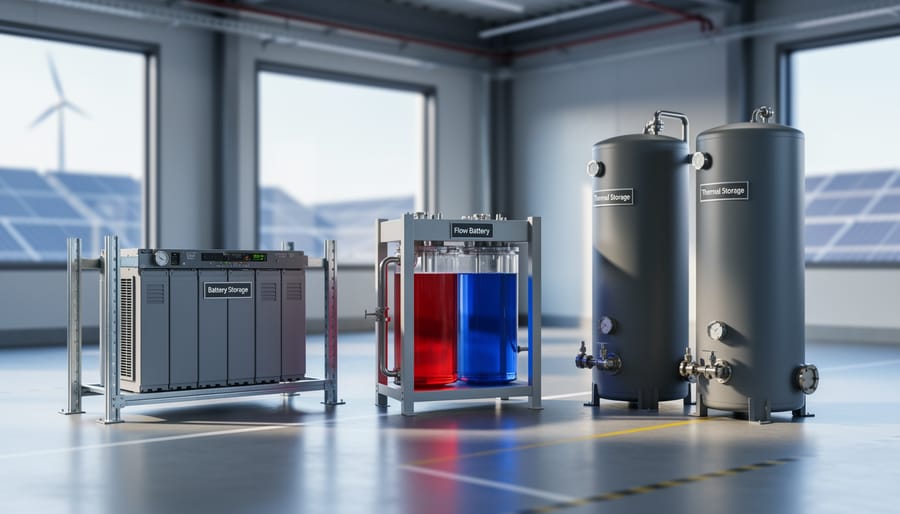
Energy storage refers to the capture of energy produced at one time for use at a later time, a capability that has become fundamental to modern renewable energy systems, grid stability, and the global transition away from fossil fuels. As solar panels generate power only when the sun shines and wind turbines only when the breeze blows, storage technologies bridge the gap between intermittent generation and constant demand, transforming variable renewable sources into reliable, dispatchable power.
The landscape of storage solutions has expanded dramatically over the past decade. What began primarily as pumped hydroelectric facilities and lead-acid batteries has evolved into a diverse ecosystem of technologies, each with distinct characteristics, cost profiles, and ideal applications. Lithium-ion batteries now dominate the residential and utility-scale markets, but emerging alternatives like flow batteries, compressed air systems, and thermal storage are carving out specialized niches where their unique advantages shine.
Understanding these options matters because the right storage choice depends entirely on context. A homeowner installing rooftop solar faces different constraints than a utility managing gigawatt-hours of grid capacity or a remote industrial facility requiring days of backup power. Duration, power output, cycle life, energy density, and capital costs all factor into the decision, and no single technology excels across every metric.
This article provides a comprehensive examination of the major energy storage technologies available in 2026, from established solutions to cutting-edge innovations. We’ll explore how each technology functions at a fundamental level, examine the distinct categories and their trade-offs, and identify where each finds its most practical application. Whether you’re evaluating storage for a specific project or seeking to understand the broader technological landscape shaping energy systems worldwide, this guide offers the technical depth and practical perspective needed to navigate an increasingly complex field.
What Energy Storage Means for Modern Power Systems
Energy storage, in its simplest form, is the practice of capturing energy at one time to use at another. For power systems, this seemingly straightforward concept addresses one of the most fundamental challenges in electricity supply: generation and consumption must remain balanced at every moment, or the grid becomes unstable.
Traditional power systems relied on dispatchable generation, fossil fuel and nuclear plants that operators could ramp up or down to match demand as it fluctuated throughout the day. Renewable energy, particularly solar, upends this model. Solar panels generate electricity when the sun shines, not necessarily when consumers need it most. A residential solar array produces peak power at midday, while household electricity demand typically peaks in early evening when people return home. On a larger scale, solar farms flood the grid with cheap energy during sunny afternoons, yet contribute nothing after sunset when air conditioning loads remain high or when winter evenings drive heating demand.
This mismatch creates a storage imperative. Energy storage systems capture excess generation during periods of peak production, those sunny midday hours, and release it during high demand or low production periods. The stored energy bridges the gap between when renewable resources are available and when electricity is actually needed, transforming intermittent generation into dispatchable power.
Understanding energy storage requires familiarity with several key technical concepts:
- Capacity vs. Power
- Capacity (measured in watt-hours or kilowatt-hours) refers to the total amount of energy a system can store, while power (measured in watts or kilowatts) describes how quickly it can discharge that energy. A system might store 10 kWh but only deliver 2 kW, meaning it takes five hours to fully discharge.
- Round-trip Efficiency
- The percentage of input energy that can be recovered from a storage system after accounting for conversion and retention losses. A system with 85% round-trip efficiency returns 85 kWh for every 100 kWh stored.
- Discharge Duration
- How long a fully charged storage system can sustain its rated power output. Systems range from seconds (power quality applications) to hours (daily cycling) to months (seasonal storage).
- Energy Density
- The amount of energy stored per unit of volume or mass, critical for applications where space or weight constraints matter, such as mobile systems or urban installations.
These technical parameters determine which storage technologies suit particular applications, from grid-scale installations smoothing renewable variability across entire regions to residential batteries providing backup power during outages.
How Energy Storage Systems Work
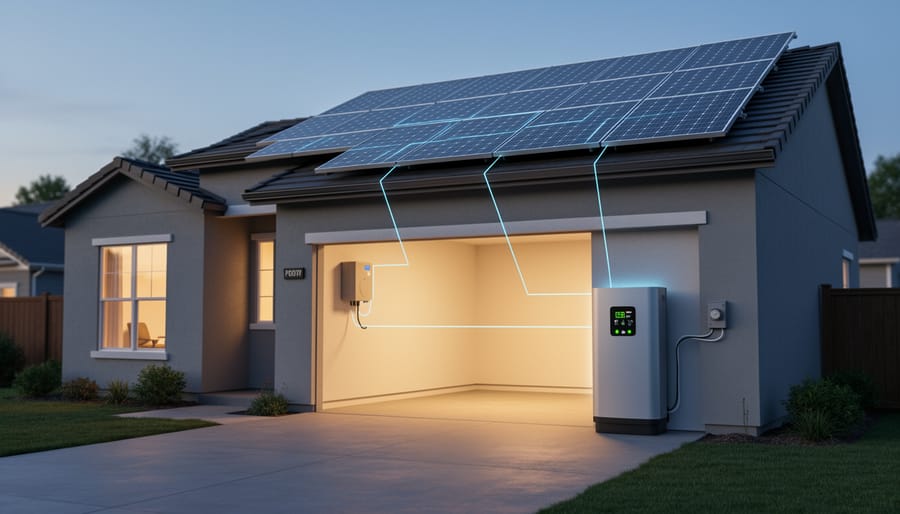
At their core, all energy storage systems operate through three fundamental stages: charging, storage, and discharging. During charging, electrical energy flows into the system and converts into another form, chemical potential in batteries, gravitational potential in pumped hydro, kinetic energy in flywheels, or thermal energy in molten salt systems. The storage phase maintains that energy with minimal losses until needed. Discharging reverses the process, converting the stored energy back into electricity for the grid or end users.
The charging phase requires power electronics to condition incoming electricity to match the storage medium’s requirements. A solar farm producing DC power might feed directly into batteries, but AC grid power needs conversion. Voltage levels, current characteristics, and charging rates must align with the storage technology’s specifications. Fast charging stresses systems differently than slow trickle charging, affecting both efficiency and longevity.
During storage, all systems experience self-discharge, the gradual loss of stored energy over time. Lithium-ion batteries lose roughly 1-3% monthly. Pumped hydro loses almost nothing over weeks. Hydrogen stored under pressure can escape through tank walls. The storage duration that makes economic sense depends heavily on these loss rates. Short-duration technologies excel at daily cycling; low-loss systems become viable for seasonal storage.
Discharge efficiency determines how much of the stored energy actually reaches the grid. Round-trip efficiency multiplies charging efficiency by discharge efficiency, yielding the overall system performance. A battery with 95% charging efficiency and 95% discharge efficiency achieves 90% round-trip efficiency, you get back 90 cents on the energy dollar. Pumped hydro typically reaches 75-82%. Power-to-gas hydrogen systems currently achieve 35-45%, though they compensate with seasonal storage capabilities no battery can match.
Control systems orchestrate these processes. Advanced battery management systems monitor individual cell temperatures and voltages, balancing charge across hundreds or thousands of cells. Grid-scale installations require sophisticated software predicting electricity prices, weather patterns, and demand curves to optimize charging and discharging schedules. These systems communicate with grid operators through standard protocols, responding to frequency deviations in milliseconds or scheduling bulk energy shifts hours ahead.
Inverters and power electronics form the critical interface between storage and grid. They convert DC battery output to AC grid power, synchronize frequencies, manage voltage, and ensure power quality. Bidirectional inverters handle both charging and discharging. In grid-connected systems, they must meet strict standards for harmonics, reactive power, and fault response. The inverter often represents 10-15% of total system cost but determines much of the system’s flexibility and grid compatibility.
Major Categories of Energy Storage Technologies
Electrochemical Storage: Battery Technologies
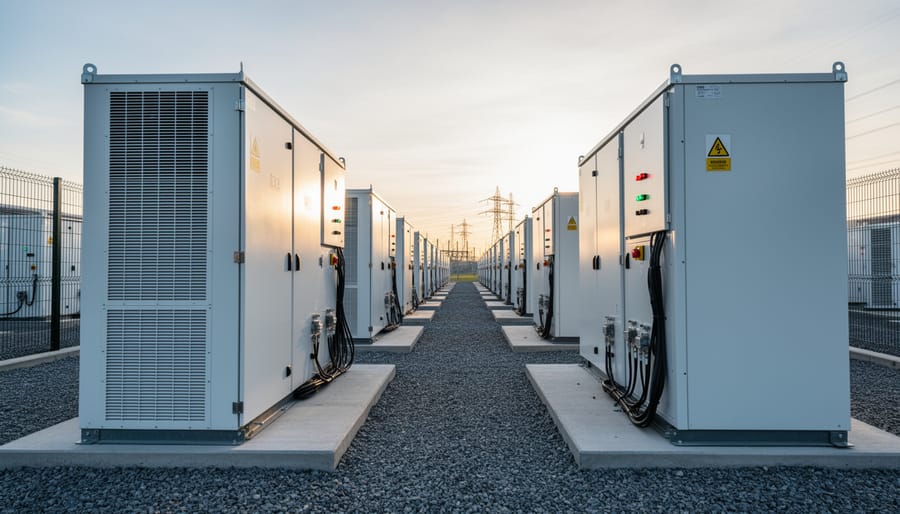
Batteries convert chemical energy into electrical energy through reversible reactions, making them the most versatile and widely deployed storage technology for solar installations. The electrochemical category dominates residential and commercial solar systems because batteries can be scaled from kilowatts to hundreds of megawatts, respond instantly to demand changes, and integrate seamlessly with existing solar inverters.
Lithium-ion batteries have captured roughly 90% of new grid-scale storage deployments since 2020. These batteries use lithium compounds that shuttle ions between electrodes during charge and discharge cycles. The technology comes in several chemistries: lithium iron phosphate (LFP) offers superior safety and 4,000-6,000 cycle lifespans but lower energy density; nickel manganese cobalt (NMC) delivers higher energy density for space-constrained applications; and lithium titanate (LTO) enables ultra-fast charging for specialized uses. Round-trip efficiency typically reaches 85-95%. Residential systems pair 5-15 kWh battery packs with rooftop solar to shift daytime generation into evening peaks, while utility projects deploy 100-300 MWh installations for four-hour discharge durations. The technology’s weakness remains its relatively short discharge window and degradation with deep cycling at temperature extremes.
Flow batteries pump liquid electrolytes through a reaction chamber, separating power capacity (determined by stack size) from energy capacity (determined by tank volume). Vanadium redox flow batteries circulate vanadium solutions in different oxidation states, offering 10,000-20,000 cycles with minimal capacity fade because the electrolyte never degrades chemically. Zinc-bromine systems cost less but face shorter lifespans. These batteries excel at 4-12 hour discharge applications where utilities need to store midday solar for overnight dispatch, particularly in markets shaped by global solar partnerships requiring long-duration reliability. Flow batteries respond more slowly than lithium-ion and require larger footprints, limiting residential adoption while gaining traction for grid projects in China, Europe and North America.
Sodium-sulfur batteries operate at 300-350°C, using molten sodium and sulfur separated by a ceramic electrolyte. They achieve high energy density and thousands of cycles but need continuous heating and protective enclosures, confining use to stationary grid-scale installations of 1-50 MW. Japan deployed over 500 MW for load leveling, though safety incidents slowed adoption elsewhere.
Solid-state batteries replace liquid electrolytes with solid conductors, potentially doubling energy density while eliminating fire risk. Prototypes demonstrate 1,000+ cycles, but manufacturing challenges and costs keep the technology 3-5 years from commercial solar applications.
Mechanical Storage Systems
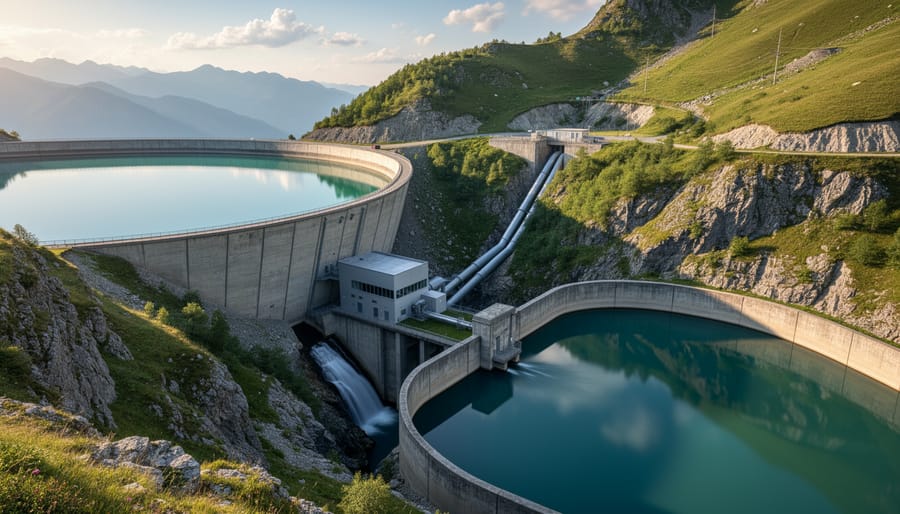
Mechanical storage systems convert electrical energy into potential or kinetic energy, holding it in physical form until it’s needed again. These technologies have existed for decades and offer some of the largest storage capacities available, though they come with specific geographical and engineering constraints.
Pumped hydroelectric storage dominates the landscape, accounting for over 95% of the world’s largest energy storage capacity installed today. The concept is straightforward: excess electricity pumps water from a lower reservoir to an upper one, storing energy as gravitational potential. When power is needed, water flows back down through turbines, generating electricity. Modern pumped hydro plants achieve round-trip efficiencies between 70% and 85%, with some advanced facilities reaching 87%. These systems can provide gigawatt-scale power for hours or even days, making them invaluable for balancing grids with high renewable penetration. The catch is geography. You need substantial elevation difference, reliable water supply, and suitable geology, requirements that limit where these plants can be built. Environmental and social considerations around reservoir creation also influence site selection, particularly in densely populated regions.
Compressed air energy storage takes a different approach, using surplus electricity to compress air into underground caverns, depleted gas fields, salt domes, or hard rock formations. When electricity is needed, the compressed air is released and heated before driving turbines. Conventional CAES plants burn natural gas during the expansion phase to reheat the air, which reduces overall emissions benefits. Newer adiabatic CAES systems capture and store the heat generated during compression, then use that stored thermal energy during expansion, eliminating fossil fuel consumption and boosting round-trip efficiency to around 70%. The technology offers storage durations from several hours to days and can reach hundreds of megawatts, but finding suitable underground geology presents a significant barrier to widespread deployment.
Flywheel systems store energy by spinning a massive rotor at high speeds, sometimes exceeding 16,000 rpm, in a low-friction environment. They excel at delivering high power for short bursts, typically seconds to minutes, making them ideal for grid frequency regulation and power quality applications rather than long-duration storage. Flywheels respond nearly instantaneously, discharge and recharge rapidly without degradation, and can cycle hundreds of thousands of times over a 20-year lifespan. Their limitations lie in energy density and duration; storing large amounts of energy for extended periods isn’t economically viable with current flywheel technology.
Thermal Energy Storage
Thermal energy storage captures heat for later use rather than converting it to electricity first, making it highly efficient for applications where the end product is either heat or electricity generated through thermal cycles. This approach proves particularly valuable in concentrated solar power (CSP) plants and industrial processes requiring high-temperature heat.
Sensible heat storage works by raising the temperature of a storage medium without changing its phase. Molten salt systems dominate utility-scale CSP plants, typically using a mixture of sodium and potassium nitrates that remains liquid between 220°C and 565°C. During sunny periods, mirrors concentrate sunlight to heat the salt, which flows to insulated tanks where it can maintain temperature for hours or days. When electricity is needed, the hot salt generates steam to drive conventional turbines. Spain’s Gemasolar plant demonstrated 15-hour storage capacity, enabling power generation through the night. Concrete, ceramics, and specialized oils serve as alternatives depending on temperature requirements and cost constraints.
Latent heat storage achieves higher energy density by exploiting phase transitions, usually solid-to-liquid. Phase-change materials (PCMs) absorb substantial energy at a nearly constant temperature as they melt, then release it when solidifying. Salt hydrates, paraffins, and fatty acids cover temperature ranges from 0°C to over 100°C, suited to building climate control, industrial waste heat recovery, and lower-temperature solar applications. Encapsulated PCMs integrate into building materials or heat exchangers, providing passive temperature regulation with minimal moving parts.
Thermochemical storage stores energy in reversible chemical reactions, such as calcium oxide combining with water. These systems operate at higher temperatures (400°C to 1,200°C) with minimal heat loss over extended periods, theoretically enabling seasonal storage. Current deployments remain limited due to complexity and cost, but pilot projects in Germany and Australia are testing integration with industrial processes.
Storage duration ranges from hours (molten salt) to potentially months (thermochemical), with round-trip efficiencies typically between 50% and 90% depending on the specific technology and application temperature.
Chemical Storage: Hydrogen and Synthetic Fuels
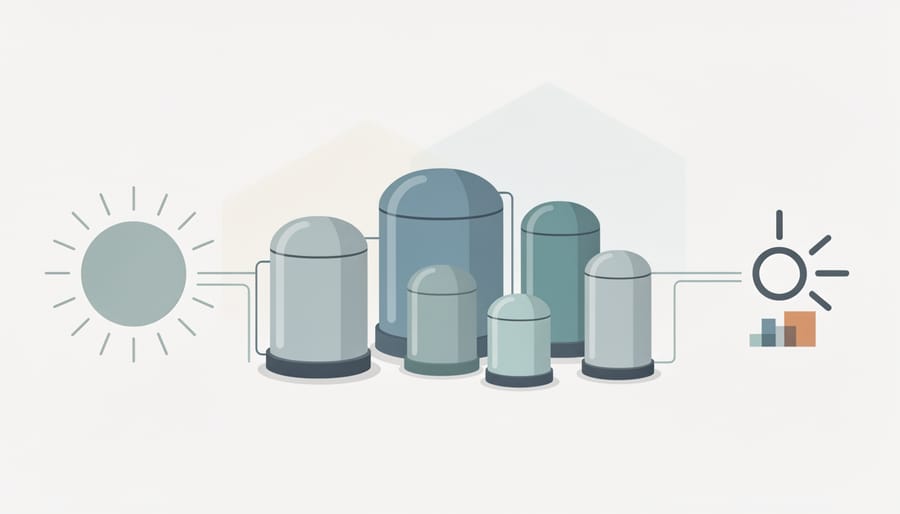
Chemical energy storage converts excess electricity into transportable fuel molecules, with hydrogen leading this category as a versatile energy carrier. When renewable generation exceeds immediate demand, electrolyzers split water into hydrogen and oxygen using electrical current. This hydrogen can then be stored for weeks, months, or even across seasons, addressing the intermittency challenge that limits other storage technologies.
Three hydrogen storage methods dominate current applications. Compressed hydrogen requires high-pressure tanks (typically 350-700 bar) and suits applications where volume matters less than simplicity. Liquefied hydrogen achieves higher energy density but demands cryogenic temperatures below -253°C, consuming roughly 30% of the stored energy just for liquefaction. Material-based storage, where hydrogen bonds to metal hydrides or porous materials, offers safer handling at lower pressures but adds weight and cost. Each method trades off energy density, safety requirements, and infrastructure complexity.
Converting stored hydrogen back to electricity happens through fuel cells, which electrochemically combine hydrogen and oxygen to generate power with water as the only byproduct, or through combustion turbines adapted for hydrogen fuel. Round-trip efficiency typically ranges from 30-50%, substantially lower than batteries, but the ability to store vast quantities economically makes hydrogen compelling for long-duration and seasonal applications that batteries cannot serve.
Synthetic fuels extend this concept by combining hydrogen with captured carbon dioxide or nitrogen. Power-to-methane processes create synthetic natural gas that integrates into existing pipeline infrastructure without modification. Ammonia synthesis from hydrogen and atmospheric nitrogen produces a carbon-free fuel that ships easily and stores at moderate pressures, gaining traction as both an energy carrier and maritime fuel. These synthetic pathways sacrifice additional efficiency but gain compatibility with established distribution systems and end uses.
Europe has committed over €30 billion to hydrogen infrastructure through 2030, targeting industrial decarbonization and seasonal grid support. Australia is developing export-scale hydrogen production powered by its exceptional solar and wind resources, while Japan and South Korea are building import terminals and domestic distribution networks. China’s aggressive electrolyzer manufacturing scale-up is driving equipment costs down rapidly. These coordinated national strategies recognize that chemical storage, despite efficiency penalties, uniquely enables intercontinental energy trade and addresses the multi-week to multi-month storage gap beyond the economic reach of batteries.
Electrical Storage: Capacitors and Superconductors
Electrical storage technologies operate on fundamentally different principles than batteries or mechanical systems. Rather than chemical reactions or physical displacement, they store energy directly in electric or magnetic fields, enabling response times measured in milliseconds.
Supercapacitors, also called ultracapacitors, bridge the gap between conventional capacitors and batteries. They store electrical charge at the interface between electrode surfaces and an electrolyte, achieving power densities 10 to 100 times higher than batteries. A typical supercapacitor system can deliver bursts of several megawatts for periods ranging from seconds to a few minutes. This makes them ideal for stabilizing voltage fluctuations, smoothing power output from variable renewable sources, and providing ride-through capability during momentary grid disturbances. Manufacturing facilities and data centers deploy supercapacitors to protect sensitive equipment from brief power quality events without the maintenance requirements of batteries.
Superconducting magnetic energy storage systems store energy in the magnetic field created by direct current flowing through a superconducting coil cooled to cryogenic temperatures. SMES units respond instantaneously with zero time delay, making them valuable for frequency regulation and short-term grid stabilization. The technology requires sophisticated cooling infrastructure and remains economically viable only for specialized applications where split-second response justifies the cost.
Both technologies occupy niche positions in the energy storage landscape. Their deployment is limited by high capital costs and very short discharge durations, but their unmatched power delivery and response characteristics make them irreplaceable for specific grid stability and power quality functions that longer-duration storage cannot address.
How Energy Storage Is Used in Practice
Energy storage moves from theoretical capacity to tangible value when deployed in specific applications, each shaped by distinct technical requirements and economic drivers. The residential solar-plus-storage market has expanded rapidly across Australia, California, Germany, and Japan, driven by combinations of feed-in tariff reductions, time-of-use electricity pricing, and grid reliability concerns. Homeowners use lithium-ion battery systems to store midday solar generation for evening consumption, reducing grid purchases during peak price periods and maintaining power during outages. Tesla Powerwall, LG Chem RESU, and Sonnen batteries dominate this segment, with smart capital for batteries enabling wider adoption through improved financing models.
Commercial and industrial facilities deploy storage primarily for peak demand charge management. A manufacturing plant in South Korea or a distribution center in the Netherlands might install megawatt-scale battery systems that discharge during the handful of 15-minute intervals each month when facility demand peaks, avoiding charges that can represent 30-50% of total electricity costs. These systems often pair with rooftop solar, combining generation and storage to flatten load profiles and reduce both energy and capacity charges.
Utility-scale applications demonstrate storage’s grid-service capabilities across multiple value streams:
- Frequency regulation: batteries respond within milliseconds to stabilize grid frequency, replacing slower fossil-fuel plants in markets from PJM to Great Britain
- Capacity firming: multi-hour storage systems guarantee renewable plant output during peak demand periods, enabling higher solar penetration in grids across California, South Australia, and increasingly Texas
- Black start capability: large storage installations provide the initial power needed to restart grid sections after blackouts, a service historically provided by diesel generators
- Transmission deferral: strategically located storage can delay costly transmission upgrades by managing local load growth
Island nations and remote communities represent another critical deployment context. Hawaii’s grid operator has installed dozens of battery projects to manage high solar penetration on isolated island grids. Mining operations in Western Australia and northern Canada use storage to reduce diesel consumption in off-grid power systems. These installations often combine batteries with existing diesel generators, cutting fuel costs by 30-50% while improving power quality.
Electric vehicle integration is emerging as a bidirectional opportunity. Vehicle-to-grid pilot programs in Denmark, the Netherlands, and California are demonstrating how EV batteries can provide grid services while parked, creating value streams beyond transportation. Commercial EV fleets at logistics companies use depot charging combined with stationary storage to manage demand charges while supporting fleet electrification goals.
Selecting the Right Storage Technology
Choosing an energy storage system isn’t about finding the “best” technology, it’s about matching capabilities to your specific requirements. A utility planning grid stability services needs entirely different characteristics than a homeowner adding solar panels or a factory managing demand charges.
Start with discharge duration. If you need power for seconds or minutes, frequency regulation, power quality correction, supercapacitors or flywheels deliver rapid response. Hours of storage for daily solar shifting? Lithium-ion batteries dominate residential and commercial installations. Days or weeks of backup during extended cloudy periods or seasonal balancing? Consider flow batteries, hydrogen systems, or pumped hydro where geography permits.
Power versus energy requirements matter equally. High power for short bursts (stabilizing voltage fluctuations) demands different engineering than moderate power sustained over hours (evening peak coverage). Flow batteries decouple these parameters elegantly: scale the tank for duration, scale the stack for power. Lithium-ion systems lock both together, which works fine when your power and energy needs align proportionally.
Cycle life shapes long-term economics dramatically. Daily cycling over twenty years demands robust chemistry, lithium iron phosphate or vanadium flow batteries handle thousands of deep cycles. Occasional backup use? Even basic lithium-ion or lead-acid batteries suffice, since infrequent cycling extends calendar life.
Response time varies from milliseconds (superconducting magnets) to minutes (some CAES systems). Grid operators juggling multiple services often layer technologies: batteries for instant response, pumped hydro for sustained reserves.
Geography constrains mechanical options severely. Pumped hydro requires suitable topography and water resources. Underground CAES needs appropriate geology. These site-specific barriers explain why electrochemical storage drives solar storage adoption globally, batteries install anywhere.
Economic considerations, capital cost, operating expenses, replacement cycles, ultimately determine viability. Markets with favorable renewable investment trends and supportive policies accelerate deployment of technologies that might struggle on pure economics alone. Increasingly, hybrid systems combine complementary technologies: batteries for daily cycling paired with hydrogen for weekly backup, or thermal storage integrated with battery peaking. No single solution fits every need, and the most resilient energy systems recognize this reality.
Frequently Asked Questions About Energy Storage Types
Which storage type is most efficient?
Pumped hydroelectric storage typically offers the highest round-trip efficiency at 70-85%, followed closely by lithium-ion batteries at 85-95%. Flywheel systems can exceed 90% efficiency for short-duration applications, while hydrogen storage through electrolysis and fuel cells currently achieves only 30-50% round-trip efficiency due to conversion losses.
What’s the difference between power and capacity?
Power (measured in kilowatts or megawatts) is the rate at which energy can be discharged or charged, how fast the system delivers electricity. Capacity (measured in kilowatt-hours or megawatt-hours) is the total amount of energy stored, how long the system can sustain that power output. A battery might have high power for grid stabilization but limited capacity for sustained use.
How long do different storage systems last?
Pumped hydro and thermal storage systems can operate for 50+ years with proper maintenance. Lithium-ion batteries typically last 10-15 years or 3,000-5,000 cycles before significant capacity degradation. Flow batteries offer 15-25 years with potentially unlimited cycles since electrolyte can be replaced, while flywheels may run for 20+ years with minimal degradation.
Which technology is best for home solar?
Lithium-ion batteries dominate residential storage use cases due to their compact size, high efficiency, declining costs, and mature supply chains. Systems sized for 10-15 kWh typically provide evening and overnight power after daytime solar generation, with warranties covering 10 years or more.
What storage duration is needed for grid reliability?
Grid requirements vary by application: frequency regulation needs seconds to minutes (flywheels, batteries), peak shaving requires 2-6 hours (batteries, compressed air), and seasonal balancing demands days to months (pumped hydro, hydrogen). Most grids need a portfolio of technologies with different discharge durations rather than relying on a single solution.
Are there environmental concerns with battery storage?
Lithium-ion batteries raise concerns about mining impacts (lithium, cobalt), manufacturing energy intensity, and end-of-life recycling, though recycling infrastructure is improving. Flow batteries use materials like vanadium that can be repeatedly recycled. Pumped hydro requires significant land use and can affect local ecosystems, while thermal storage using molten salts has relatively benign environmental impacts.
These questions reflect the practical considerations facing anyone evaluating energy storage systems, from homeowners adding solar batteries to utilities planning grid-scale deployments. The answers highlight that trade-offs exist across efficiency, longevity, cost, and environmental impact, no single technology excels in every dimension. Understanding these distinctions helps match storage solutions to specific needs rather than chasing a universal best option that doesn’t exist in practice.
The landscape of energy storage technologies reveals a fundamental truth: no single solution addresses every challenge in modern power systems. From the massive capacity of pumped hydroelectric installations to the rapid response of supercapacitors, from the energy density of lithium-ion batteries to the seasonal storage potential of hydrogen, each technology occupies a distinct niche defined by its physical principles and economic characteristics. This diversity isn’t a weakness, it’s a strength that allows engineers and planners to match storage solutions precisely to application requirements, whether stabilizing a remote microgrid, firming the output of a utility-scale solar farm, or enabling multi-day backup for critical facilities.
The maturation of these technologies over the past decade has fundamentally altered the economics of renewable energy deployment. Storage systems that were prohibitively expensive in 2015 now compete directly with fossil fuel peaking plants in many markets. This cost trajectory, combined with improving efficiency and longer cycle life, has enabled solar and wind penetration levels that would have been impossible with generation alone. Markets from California to Germany to South Australia demonstrate that grids can reliably operate with majority-renewable generation when paired with appropriate storage portfolios.
Looking ahead, continued innovation in materials science, manufacturing processes, and system integration promises further cost reductions and performance improvements. Renewable Solar News remains committed to tracking these developments across international markets, documenting how different regions leverage their unique resources and regulatory frameworks to deploy storage technologies that accelerate the global transition to clean energy.