
In the interest of transparency, we earn a commission on some purchases made through links on this site. As an Amazon Associate I earn from qualifying purchases.
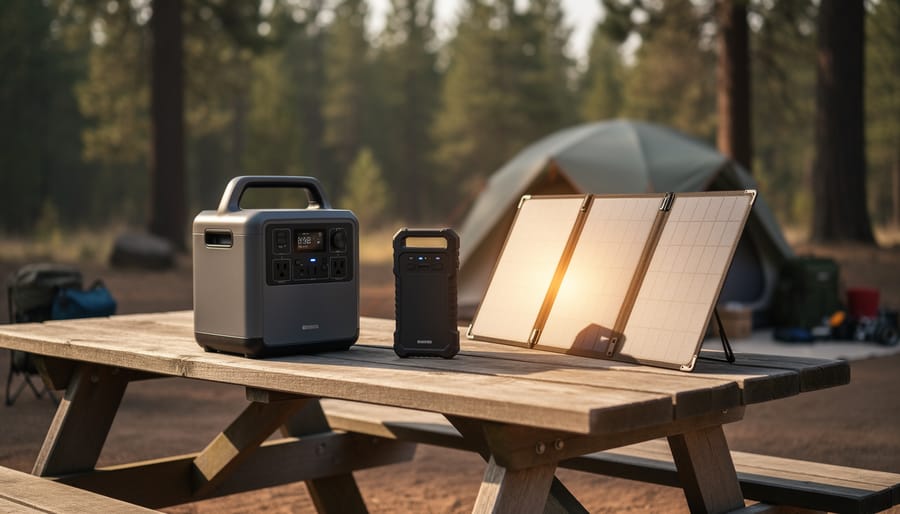
The best solar powered product is the one sized to a specific job, not the biggest panel or the highest milliamp-hour number on the box. For a phone on a day hike, a solar power bank such as the BLAVOR Solar Power Bank 10,000mAh Portable Wireless Charger is enough. For a campsite, a Collapsible Solar USB Rechargeable LED Camping Lantern Flashlight or the Brightown 52FT Solar String Lights Outdoor Waterproof covers lighting without a single cable. For running a fridge, laptop or CPAP during an outage, you need a power station like the Goal Zero Yeti 1500 Portable Power Station paired with a foldable panel such as the ZOUPW 480W Bifacial Portable Solar Panel N-Type 16BB.
One caution up front: a solar power bank’s built-in panel is a trickle charger, not a primary source. Most are best charged from the wall first, with the panel as a top-up. The real work in a solar setup happens in the battery capacity, panel wattage and the match between them.
Solar has moved a long way from the small calculators and garden lamps that first brought it into homes. Falling cell costs and the kind of cross-border manufacturing and supply ties covered in our look at global solar partnerships have put capable gear within reach of campers, homeowners and off-grid users in every market.
This guide breaks down the factors that matter, compares each product type, and flags the mistakes that cost buyers the most.
Key Buying Factors for Solar-powered Consumer Gadgets
Panel Output, Battery Capacity and the Sunlight Reality Gap
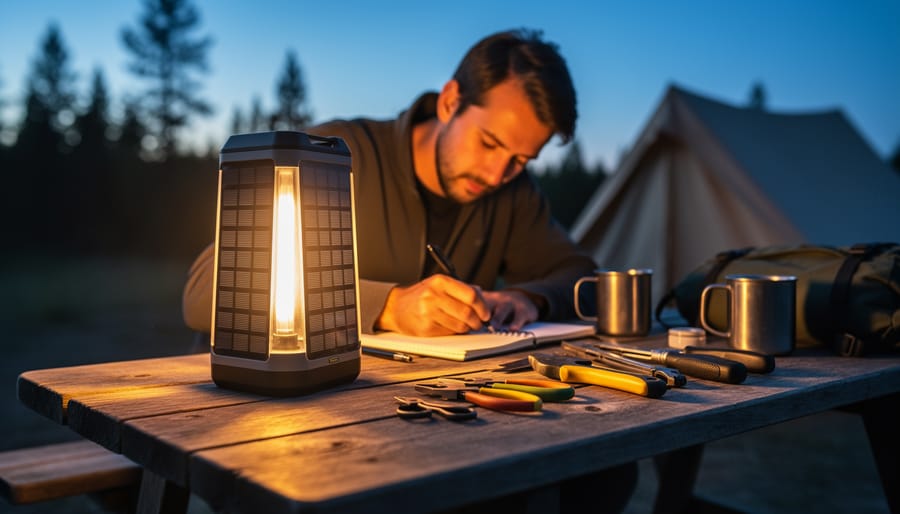
A rated 20W panel and a 20,000mAh battery describe laboratory limits, not what you will get on a patio or a hiking trail. Panel wattage is measured under standard test conditions: full, perpendicular sunlight and a controlled cell temperature. In the field, a panel that sits flat while the sun moves, or that is tilted away from it, delivers only a fraction of that figure. Even a passing cloud or a nearby branch can cut output sharply.
Battery capacity needs the same scepticism. Milliamp-hours are quoted at the cell’s internal voltage, so the energy that reaches your phone is lower once conversion losses are counted. Pair a large battery with a small panel and the arithmetic is unforgiving: you may need many days of clear weather to refill it. That is why the types of energy storage inside a gadget matter as much as the panel feeding it.
Geography changes the weighting. Readers at high latitudes face short winter days and a low sun, so panel size and tilt should take priority over headline battery capacity. In equatorial or arid regions, strong year-round sun makes a modest panel workable, and heat tolerance becomes the bigger concern. In persistently cloudy, temperate climates, treat solar as a top-up and keep a wall or USB charging option as your primary route.
Durability, Compatibility and Portability Checks
Durability starts with the ingress protection (IP) rating. The first digit covers dust and the second covers water, so IP65 means dust-tight and resistant to water jets. That is a sensible floor for anything left outdoors permanently, such as a camera panel or floodlight. Gadgets that live in a backpack can get by with less.
Compatibility is where many buyers slip. Connectors vary widely: USB-C on power banks, barrel plugs on many camera panels, and MC4 on larger portable panels that feed power stations. The 2-pack 4W Ring camera panel on Amazon’s Solar Panels Best Sellers list, for example, ships with a 10FT cable and a USB-C to barrel plug adapter, and its listing names Ring Stick Up Cam Battery/Pro, Spotlight Cam Battery/Plus/Pro and Reolink Argus Pro as compatible. That shows why matching your exact camera model matters more than the word “universal” on a box. If you are unsure how storage capacity ties into all this, our primer on battery capacity basics explains the units involved.
Weight is the last trade-off. More panel area means more output and more bulk, so a foldable panel suits car camping better than a day hike. Before buying, run through this checklist:
- Connector type: USB-C, barrel plug, or MC4, and whether an adapter is included.
- Ingress protection rating suited to permanent or occasional outdoor use.
- Output ports available for the devices you actually own.
- Charging method: solar only, or solar plus wall or USB.
- Weight and folded size for how far you will carry it.
- Mounting options such as brackets, hooks, or stands.
Check each item against your intended use before you compare prices.
Types of Solar-powered Gadgets Compared: Power Banks, Lighting and Portable Panels
Solar powered products are not interchangeable, even though they share a headline feature. What the sun actually does for each product family differs sharply, and that difference should drive your choice more than any spec sheet number.
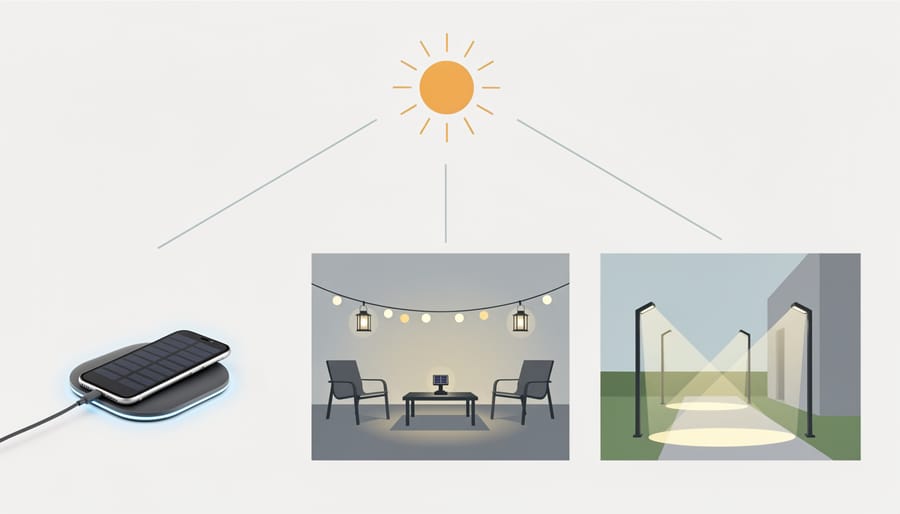
Power banks use a small onboard cell mainly as an emergency trickle charger. Portable panels and power stations are different: the panel is the primary energy source, and the battery is a buffer. Lanterns, string lights and floodlights fall in a third group, where the solar element works as a self-contained daily cycle of charging by day and lighting by night, with no cables to manage.
| Product type | Role of the solar element | Key strengths | Key limitations | Best for |
|---|---|---|---|---|
| Solar power banks | Slow emergency top-up | Pocketable, doubles as a standard power bank | Built-in cell recharges very slowly | Commuters, day hikers, outage backup |
| Portable panels and power stations | Primary charging source | Scalable output, can run larger devices | Heavier, needs open sun and matching connectors | Off-grid use, home backup, camera power |
| Camping lanterns | Daytime recharge for night light | Collapsible, no fuel, often USB-chargeable too | Limited brightness and runtime | Campers, power-cut kits |
| Decorative string lights | Fully automatic day-night cycle | No wiring, easy placement | Ambient glow only, sensitive to shade | Patios, gardens, balconies |
| Security floodlights | Autonomous charging for motion-triggered light | Bright, weatherproof, wire-free installation | Needs good mounting height and sun exposure | Driveways, perimeters, outbuildings |
The pattern matters. Where solar is the primary source, as with panels, you are buying generation capacity, so wattage, panel construction and connectors dominate the decision. Where solar is a supplement, as with power banks, you should judge the product as a battery first and treat the solar cell as a bonus. Lighting products sit in between: the panel only has to refill a small battery each day, which is why they perform best where sunlight is reliable and unshaded.
Compatibility is a category of its own for panel accessories. Amazon’s Solar Panels Best Sellers list, which it says is updated frequently, currently puts a 2-pack of 4W panels for Ring cameras at number one. It comes with a 10FT cable and a USB-C to barrel plug adapter and is described as compatible with Ring Stick Up Cam Battery/Pro, Spotlight Cam Battery/Plus/Pro and Reolink Argus Pro. A 200W portable panel for power stations sits at number two. Both are panels, but they serve entirely different jobs.
A brief note on reading rankings: research sources and retail lists tend to sort products into “best for” buckets, such as best for camping, best overall or best budget pick. These labels are useful starting points, but they reflect the reviewer’s priorities, not yours. Check whether the category matches your actual use before trusting the label.
Key Details From Current Retail Listings
Retail listings are useful for seeing what shoppers are actually buying right now, though they only capture a single moment. Amazon’s Solar Panels Best Sellers page says it is updated frequently and shows the top 100 most popular items, so treat any snapshot as a reference point rather than a fixed ranking.
At the time of research, the #1 spot went to a 2-pack of 4W solar panels designed for Ring cameras, priced at $36.99. The kit includes a 10FT cable and a USB-C to barrel plug adapter. The listing describes it as compatible with the Ring Stick Up Cam Battery and Pro, the Spotlight Cam Battery, Plus and Pro, and the Reolink Argus Pro. That compatibility list matters, because a trickle charger for a battery-powered camera only helps if the connector and device match.
At #2 sits a 200W foldable portable panel built for power stations. Its listing claims 24% efficiency using ETFE (a durable, lightweight surface coating common on portable panels), along with QC3.0 and Type-C 60W output, MC4 connectors for pairing with power stations, and IP65 waterproofing. Those are the manufacturer’s stated figures, and real-world output will depend on sunlight, angle and temperature.
These two listings show how wide the category is. One is a small, camera-specific top-up charger. The other is a larger panel meant to feed a battery bank. Since prices and rankings move, confirm what is currently available and in stock before making a decision, and don’t rely on this snapshot as a final price or ranking.
Goal Zero Yeti 1500 Portable Power Station for Home Backup and Off-Grid Use

The Goal Zero Yeti 1500 is the heavyweight of this guide, and it earns its place for a different reason than the pocket-sized gadgets above. It is a portable power station built for home backup and off-grid use, and the listing describes it as solar generator ready, meaning it is designed to be recharged from external solar panels rather than carrying a panel of its own.
The detail worth dwelling on is the battery chemistry. This unit uses LiFePO4, short for lithium iron phosphate. Compared with the more common lithium-ion cells found in many consumer devices, LiFePO4 is generally valued for a longer cycle life and better thermal stability. In practical terms, that means the battery can be charged and discharged many more times before capacity fades noticeably, and it is less prone to overheating. For something you might leave on standby for a storm season or lean on daily at a cabin, that durability matters more than shaving a little weight. If the terminology is new to you, our guide on LiFePO4 explained covers how this and other storage chemistries compare.
A power station of this class sits at the center of a system rather than working alone. To make it truly off-grid, you pair it with external panels, and this is where the portable-panel advice from earlier sections applies directly. Matching the panel’s voltage and connector type to the station’s solar input is essential, so check those specifications before you buy rather than assuming any panel will plug in.
As for owner feedback, the listing shows a rating of 4 out of 5 from 13 customer ratings. That is a small sample, so treat it as a loose signal instead of a verdict. A handful of reviews cannot tell you much about long-term reliability, which is a good reason to read the detailed comments and to weigh the manufacturer’s specifications more heavily here than the star score. The unit is currently listed as in stock, though availability changes, so confirm it before planning around it.
Best suited to: households wanting outage backup, and off-grid users prepared to invest in panels.
BLAVOR Solar Power Bank 20000mAh for Phones and Apple Watch

The BLAVOR 20000mAh model is the larger of the brand’s two solar power banks in this guide, and it adds wireless charging for phones and Apple Watch. That combination suits people who want to drop a device on a pad and walk away, rather than fiddle with cables in a bag.
Capacity is where it earns its place. A 20000mAh pack can top up a typical smartphone several times over, which makes it a sensible companion for a long day out or a power cut. Wireless charging adds convenience, though it generally runs less efficiently than a wired connection, so expect a wired cable to be the faster, more economical route when you are short on charge.
The built-in solar cell deserves honest framing. A panel small enough to sit on the back of a power bank collects only a trickle of energy, so it is a poor way to refill a 20000mAh battery from empty. Where it helps is as a last-resort emergency top-up: stranded outdoors with the pack flat, leaving it in direct sun can coax out a little reserve. For regular recharging, a wall adapter or USB source remains the practical choice, and you should treat the solar function as insurance rather than a primary charging method. If you want meaningful solar input, a dedicated portable panel, covered later in this guide, is the better tool.
The owner record is encouraging. The listing carries a 4.3 out of 5 rating from 5,362 customer ratings, a substantial base that lends the score more weight than a handful of reviews would. At the time of research it was shown as in stock, though availability changes, so check the live listing before you buy.
One practical point for international readers: very large power banks can face airline carry-on limits that vary by country and carrier, so confirm the rules for your route before flying with a 20000mAh pack.
BLAVOR Solar Power Bank 10,000mAh Portable Wireless Charger for Everyday Carry

The compact BLAVOR 10,000mAh model is the more sensible pick for people who carry a power bank every day. At this capacity, a unit slips into a jacket pocket or the side of a daypack without being noticed, which is exactly what commuters and day hikers need. Its larger sibling, the 20,000mAh version, packs more charge but also more bulk, and that trade-off is the real decision here.
For a typical day out, 10,000mAh is plenty. It covers a phone top-up or two between a morning train and an evening walk home, and the wireless charging pad means you can skip the cable when you only need a quick boost. If you routinely run several devices or stay out overnight, the bigger sibling makes more sense. Otherwise, the smaller bank’s lighter weight tends to matter more than the extra reserve.
A word on the solar element, since it is easy to overrate. The built-in cell on a bank this size is best treated as an emergency trickle, not a primary charging method. Plan on charging it from a wall or USB source before you leave, and think of the panel as a bonus on a long, sunny stretch of trail. If you clip it to a pack or leave it on a windowsill, a few of the same principles apply as for any exposed solar gear, and our outdoor mounting tips offer useful context on positioning for sunlight.
The listing shows a 4.2 out of 5 rating from 48,028 customer ratings, and it is currently in stock. That review base is large enough to give the score real weight; a sample this size is far less likely to be skewed by a handful of unusually happy or unhappy buyers. It suggests broadly consistent satisfaction among everyday users, though it cannot tell you how the unit will suit your specific routine, so check your phone’s charging needs against the capacity first.
Solar Power Bank 38800mAh for Extended Trips

The 38800mAh power bank sits at the extreme end of the category, and it makes sense only if your trips are long and your device list is longer. Think multi-day travel, a phone plus a tablet, maybe a camera or a headlamp, all drawing from one battery before you reach a wall socket again. Its listing carries a customer rating of 4.1 out of 5 from 10,051 customer ratings, and it is shown as in stock.
Here is the catch that readers in any climate should understand. The solar cells on a power bank of this size are tiny compared with the battery behind them. Capacity is measured in mAh, essentially how much charge the cells can hold, while the panel’s trickle of input is measured in small fractions of that over many hours of strong sun. Refilling a battery this large from the built-in panel alone would take far longer than most trips allow, and it assumes the bank sits still in direct light the whole time. Treat the solar surface as an emergency top-up, not a primary charging method. Plan on wall or USB charging before you leave, the same way you would size a proper solar system setup around realistic sunlight rather than a best-case number on a label.
Weight is the other cost. More cells mean a heavier, bulkier unit, which matters if you carry it all day. It also matters at the airport. Airlines generally restrict lithium batteries by their watt-hour rating and require power banks in carry-on luggage, not checked bags. Large-capacity banks can approach or exceed those limits, so check your airline’s current rules before you fly.
Choose this model for long stretches away from outlets, and a smaller bank if you mostly want a light daily carry.
Collapsible Solar USB Rechargeable LED Camping Lantern Flashlight for Camp and Power Cuts

A collapsible solar lantern earns its place in two situations: the campsite and the power cut. Its main appeal is packability. When collapsed, the body shrinks to a flat, compact shape that slips into a daypack, a glovebox or an emergency kit without taking meaningful space. Expanded, it throws light across a tent or a living room, which is more useful than the narrow beam of a flashlight.
The Collapsible Solar USB Rechargeable LED Camping Lantern Flashlight carries a customer rating of 4.4 out of 5. Its availability is listed as usually shipping within 5 to 6 days, so if you want it ready before storm season or a trip, order with that lead time in mind.
The feature that matters most is dual charging. A built-in solar panel lets the lantern top up outdoors, while USB charging gives you a reliable fallback indoors or on cloudy days. For an outage kit, that second route is the sensible default: charge it fully from a wall adapter or power bank before you store it, then treat the solar panel as a way to extend runtime when the grid stays down.
Set your expectations on runtime. Small lantern panels recover charge slowly, and a few hours of direct sun will not match a full USB charge. Brightness settings also change how long a charge lasts, so running at the lowest comfortable level stretches a battery considerably. The listing data here does not give a tested runtime figure, so check the current product page for the manufacturer’s stated numbers.
Best for campers who value weight and space, and for households building a simple, low-effort outage kit.
Brightown 52FT Solar String Lights Outdoor Waterproof for Patios and Gardens

The Brightown 52FT string lights suit patios, pergolas and garden borders, where the goal is atmosphere rather than task lighting. It is one of the simpler products in this guide, and that is part of its appeal: a single panel, a long string and no wiring to run. Even a modest gadget like this reflects the broader shift in consumer solar, and readers interested in that bigger picture can follow renewable investment trends to see how capital keeps flowing into the sector.
The listing advertises a runtime of 30+ hours and describes the lights as outdoor waterproof. Treat that runtime as a best-case figure. Solar string lights draw on a small internal battery, and how long they glow on any given night depends on how fully the panel charged that day. A full charge in strong sun is what a “30+ hours” claim assumes, so expect shorter evenings after overcast days or in winter, when daylight hours shrink and the sun sits lower in the sky. Readers at higher latitudes should weight this more heavily than those in sunnier regions.
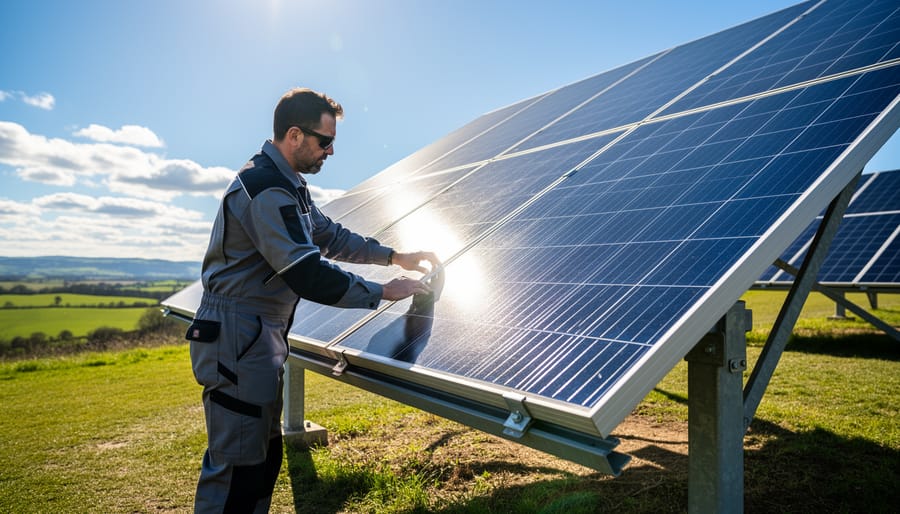
Panel placement matters more than any spec on the page. The panel needs direct, unobstructed light for as many hours as possible, so avoid mounting it under eaves, tree canopy or a fence line that shades it by mid-afternoon. A separate panel on a lead is useful here, because the lights can be draped in a shaded seating area while the panel sits in the open. Keep the panel clean too, since dust and pollen quietly reduce charging. And if the string is going up permanently, check the waterproof claim against your exposure to driving rain rather than assuming it covers every condition.
On buyer feedback, the listing carries a 4.4 out of 5 rating from 2,776 customer ratings, a reasonably large base that suggests consistent satisfaction for decorative use. It is listed as in stock, though availability can change, so confirm before ordering.
Tuffenough Solar Outdoor Lights 2500LM 210 LED Security Lights with Remote Control for Perimeter Security

The Tuffenough two-pack suits buyers who want perimeter security without running mains wiring. Each pack contains lights with three heads, motion sensing and a remote control with three modes. The listing specifies IP65 waterproofing and a 270-degree wide-angle flood pattern, the kind of coverage that matters along fence lines, side yards and driveways. IP65 means the housing is dust-tight and resists water jets, which is a sensible baseline for a fixture that will stay outdoors year-round.
Owner feedback is unusually deep for this category. The listing shows 4.4 out of 5 from 42,199 customer ratings, and it is currently in stock. A rating base that large is a reasonable signal of consistent real-world satisfaction, though it cannot tell you how the lights will behave at your particular address.
That is where installation matters most. Mounting height shapes both detection and coverage. Mount too low and the sensor trips on small animals and swaying plants; mount too high and it may miss people at the edge of its range. Sensor placement deserves equal thought: aim the heads across the likely path of movement rather than straight at it, since passive infrared sensors tend to register crossing motion more reliably than approach head-on. Shading is the quiet failure mode. A solar-powered security light that sits under an eave or a tree canopy will charge poorly, and a flat battery means no light when you need it. Check where the panel receives direct sun at midday, and remember that winter sun at higher latitudes sits lower and shorter.
If you enjoy tinkering with outdoor power setups, our notes on DIY solar considerations cover the same principles of orientation and exposure. For these floodlights, the practical advice is simple: choose a bright, unobstructed spot, test the sensor at dusk, and adjust before fixing anything permanently.
ZOUPW 480W Bifacial Portable Solar Panel N-Type 16BB for Pairing With Power Stations
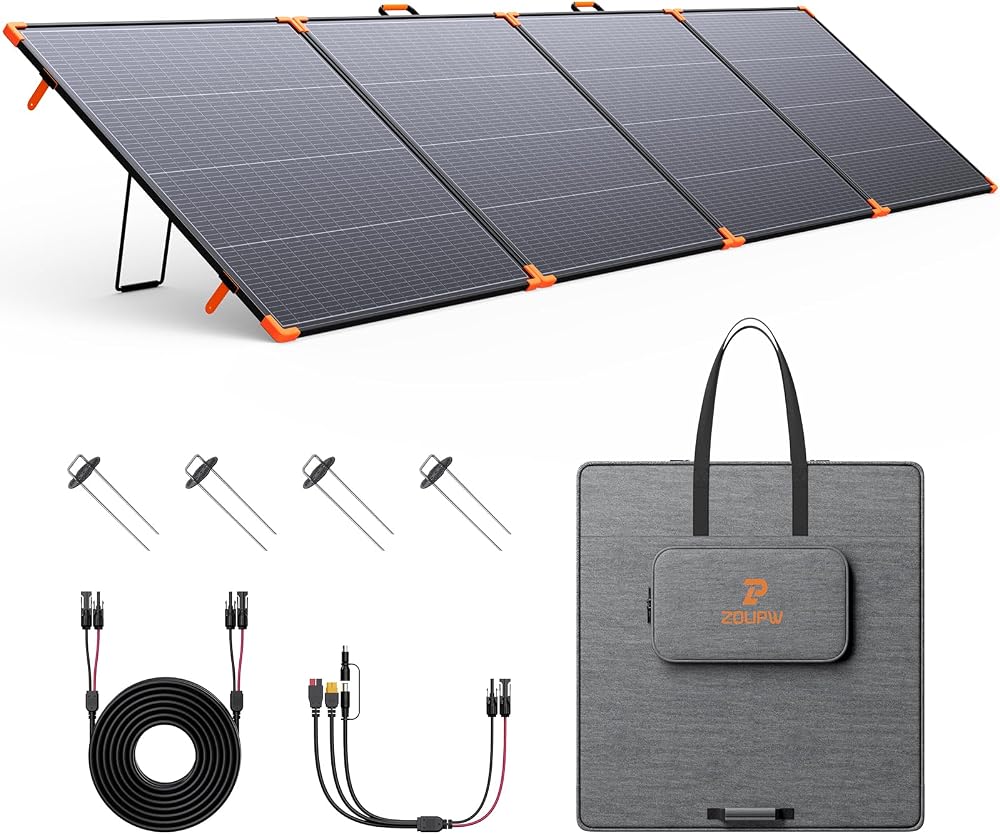
The ZOUPW 480W panel is built around two technologies worth understanding before you buy: bifacial construction and N-type cells. A bifacial panel has active cells on both faces. The front captures direct sunlight, while the rear collects light reflected from the ground. N-type cells use a different silicon doping than the older P-type design, and they are generally valued for better performance in heat and slower degradation over time. The “16BB” in the name refers to 16 busbars, the thin metal lines that collect current from each cell.
The rear-side gain is the part buyers most often overestimate. It depends almost entirely on what is under the panel. Light-colored, reflective surfaces such as pale concrete, snow, or white gravel send more light back to the rear cells, while dark soil or grass returns far less. On a campsite lawn, expect the rear face to contribute little. Treat any bifacial bonus as a variable, not a guarantee, and judge the panel mainly on its front-side performance.
At this wattage, the panel is designed to feed a portable power station, not charge a phone directly. Pairing comes down to three checks: the panel’s operating voltage must fall within the station’s solar input window, the combined wattage should not exceed the station’s maximum input, and the connectors must match. MC4 is common on larger panels, while many stations accept barrel plugs or XT60 inputs, so an adapter cable is often needed. Check the station’s manual rather than assuming compatibility.
Owner feedback is positive but thin. The listing shows 4.7 out of 5 from 69 customer ratings, a small sample compared with the thousands behind many consumer gadgets, so treat that score as encouraging rather than conclusive. It is listed as in stock. For readers with a station already in hand and a sunny, open site, this is a logical expansion option. For anyone without one, a smaller panel or power bank is the more sensible starting point.
Which Solar Gadget Fits Which Buyer: Recommendations by Use Case
Matching a gadget to a job is easier than comparing spec sheets, so here is how the eight profiled products sort by use case. Ratings come from the listings discussed earlier, and I’ve left out prices where none were verified.
| Use case | Recommended product | Customer rating | Why it fits |
|---|---|---|---|
| Emergency phone top-ups | BLAVOR Solar Power Bank 10,000mAh | 4.2 out of 5 (48,028 ratings) | Compact, with a very large review base |
| Multi-day travel | Solar Power Bank 38800mAh | 4.1 out of 5 (10,051 ratings) | Capacity for several devices |
| Camping and outage kits | Collapsible Solar USB Rechargeable LED Camping Lantern | 4.4 out of 5 | Packable, solar and USB charging |
| Home security | Tuffenough Solar Outdoor Lights 2500LM | 4.4 out of 5 (42,199 ratings) | Motion sensing, IP65, 270-degree coverage |
| Home backup | Goal Zero Yeti 1500 | 4 out of 5 (13 ratings) | LiFePO4 chemistry, solar-generator ready |
For backyard ambiance, the Brightown 52FT Solar String Lights (4.4 out of 5 from 2,776 ratings) are the natural pick, since they exist purely to light a patio or garden after dark. Wireless-charging users with an Apple Watch or phone should look at the BLAVOR 20000mAh model (4.3 out of 5 from 5,362 ratings), which trades some portability for capacity.
Power-station expansion is the one case where a panel, not a gadget, does the work. The ZOUPW 480W Bifacial panel (4.7 out of 5, though from only 69 ratings) is the roster’s high-wattage option for pairing with a station like the Yeti 1500. Check that voltage and connectors match before you buy.
Treat the thin rating samples on the Yeti and the ZOUPW with some caution. A few dozen opinions are a hint, not a verdict. If you’re unsure where to start, buy for the job you’ll actually do most often, whether that’s a lantern for outages or a floodlight for the driveway.
Common Solar Gadget Buying Mistakes to Avoid
Most disappointing solar purchases come down to a handful of avoidable errors. Treat the built-in solar cell on a power bank as an emergency top-up, not a primary charger, because it simply cannot replace a wall or USB charge. Capacity gets oversold the same way. A 38800mAh bank sounds impressive, but a small panel would need a very long run of strong sun to refill it, so the extra size mostly adds weight.
Compatibility is the other quiet trap. Connector standards vary, and a panel that fits one device may not fit another. The Ring-style camera panel on Amazon’s Solar Panels Best Sellers list, for instance, ships with a 10FT cable and a USB-C to barrel plug adapter, and is described as compatible with specific Ring and Reolink models, not every camera brand.
- Expecting fast solar recharging from a power bank: use solar for emergencies and charge from the wall or USB in normal use.
- Ignoring connectors and device lists: check the exact plug type and the named compatible models before buying.
- Buying more capacity than sunlight can refill: size the battery to what a realistic day of sun can restore.
- Trusting ratings built on tiny samples: weigh a 4.7 from 69 ratings more cautiously than a 4.2 from tens of thousands.
- Placing panels in shade: mount or angle them for the longest direct exposure, away from trees and eaves.
- Skipping waterproof ratings on permanent installs: look for a stated rating such as IP65 for anything left outdoors year-round.
Ratings deserve particular scepticism. Review volume matters as much as the star score, since a small sample can swing high or low on a handful of opinions. Shade is the other classic failure, and even a partial shadow across a cell can sharply cut output, so a light that works in the garden centre may underperform once mounted under a roofline. Finally, a permanent outdoor fixture faces rain, dust and temperature swings season after season, which is why a stated ingress-protection rating should be a baseline requirement rather than a bonus.
Solar-powered Gadget Buying FAQs
Buying solar gadgets raises the same handful of practical questions again and again. These answers rely on how the technology works, plus the listing details verified for this guide.
Can a solar power bank fully recharge from the sun alone?
In theory, yes, but in practice it takes a very long time. The small built-in cells on most power banks produce only a trickle of current, so they work best as an emergency top-up while wall or USB charging does the heavy lifting.
Do solar gadgets work on cloudy days?
They still generate some power under cloud cover, but output drops sharply compared with direct sun. Expect slower charging and shorter runtimes, and plan for a backup charging method if you depend on the device.
What does IP65 mean?
IP65 is an ingress-protection rating: the first digit means the device is dust-tight, and the second means it withstands low-pressure water jets. It suits rain and splashes, but it does not cover full submersion.
Can a portable panel charge a power station?
Generally yes, provided the panel’s voltage range and connector match the station’s solar input. A listing for a 200W foldable panel, for example, advertises MC4 output, which is a common connector standard, though you should confirm input limits in the station’s manual.
Are solar camera panels compatible with every camera brand?
No. Compatibility depends on the connector and the camera’s charging port. One top-listed 2-pack, 4W panel names Ring Stick Up Cam Battery/Pro, Spotlight Cam Battery/Plus/Pro and Reolink Argus Pro, so check the stated model list before buying.
A common thread runs through all five answers: the rated numbers on a box describe ideal conditions, not your backyard or campsite. Before you commit, read the connector type, the stated compatibility list and the waterproof rating, then match them against where the product will actually live. Listings and availability change often, so verify current specifications at the point of purchase.
Choosing well comes down to one habit: start with the job, then match the hardware to it. A phone-charging bank needs modest capacity and a realistic view of how slowly a small built-in cell refills it. A camping lantern or string light cares more about packability, runtime and weather sealing. A power station and its panels turn on watt-hours, connector standards and chemistry. Whatever the category, three questions settle most decisions: how much battery do you truly need, how much sun will you honestly get, and will the product survive the conditions and plug into the devices you own.
It is worth remembering how far this category has travelled. Our family-run publication began in 1947, when solar power was a laboratory curiosity. Today, solar gadgets sit on retail best-seller lists, from compact panels built for battery-powered security cameras to foldable portable panels sized for power stations. That progress is real, but it has not repealed the basic constraint: sunlight varies by latitude, season and weather, wherever in the world you live.
Because retail listings change frequently, treat every figure in this guide as a starting point. Before you buy, confirm current availability, connector types, compatibility with your specific device and the waterproof rating on the live product page. A few minutes of checking will keep a good idea from becoming a disappointing purchase.