
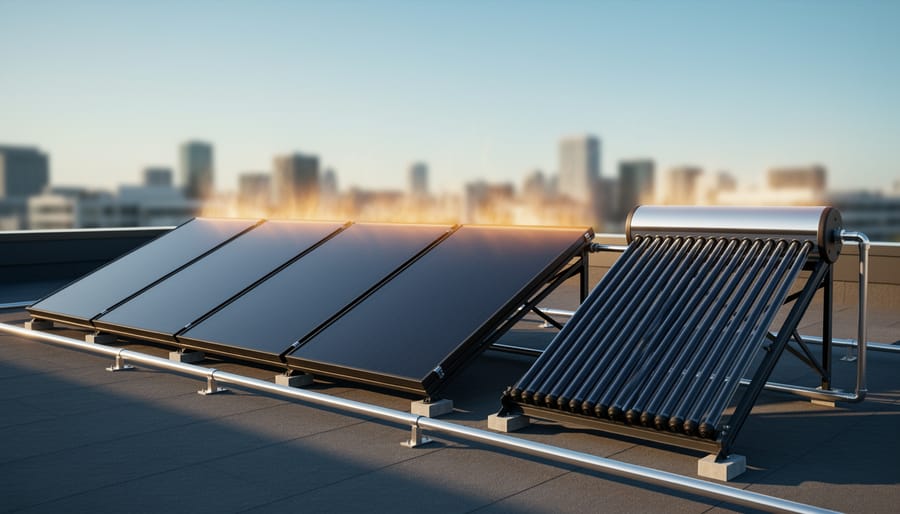
Solar thermal energy is the capture of sunlight as heat, rather than as electricity, using collectors or mirrors that concentrate or absorb solar radiation and transfer it to a working fluid such as water, oil, air, or molten salt. That heat can warm a building, drive an industrial process, or boil water into steam to spin a turbine. Photovoltaic panels convert photons directly into current, while solar thermal systems work with the energy as heat first, and that difference shapes everything about how each technology is built, stored, and deployed.
The distinction matters more than it might seem. Heat is the largest single form of final energy demand worldwide, and much of it still comes from burning fossil fuels for hot water, space conditioning, and industrial steam. Solar thermal addresses that load directly, and it pairs naturally with low-cost thermal storage, which lets concentrating plants keep delivering after sunset in a way batteries alone struggle to match at scale.
The idea isn’t new. Engineers were focusing sunlight to raise steam well over a century ago, and simple flat-plate collectors have heated domestic water for generations, from Mediterranean rooftops to Chinese apartment blocks. What has changed is the sophistication of the systems and the range of places they work.
This article defines the technology in plain terms, explains how it converts sunlight into usable heat, compares the main collector types, and shows where it’s applied across homes, industry, and utility-scale power.
What Solar Thermal Energy Means: Heat, Not Electricity
Solar Thermal vs. Photovoltaics: Two Ways to Harvest the Sun
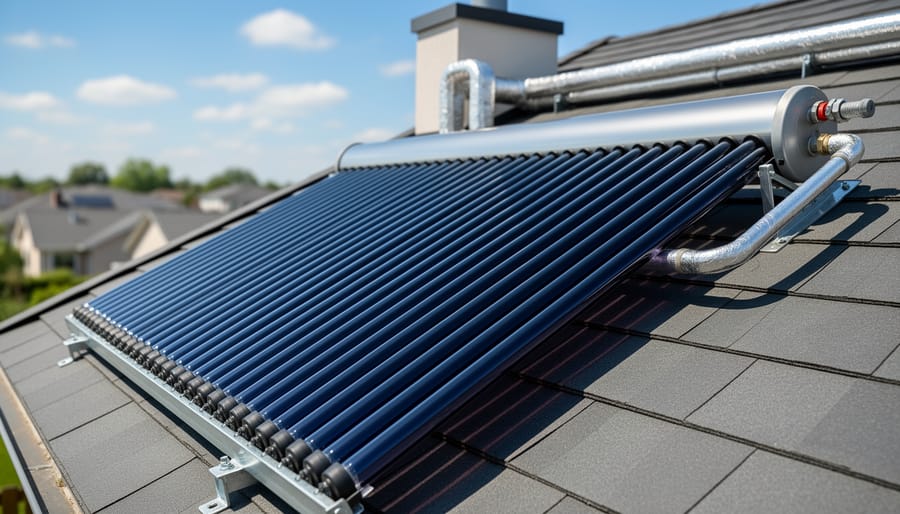
Solar thermal and photovoltaic systems both harvest the sun, but they capture different things. A photovoltaic panel converts light directly into electricity, while a solar thermal system absorbs sunlight and turns it into heat. That difference shapes everything else: outputs, storage and efficiency.
Photovoltaic output is electrical, ready for lighting, appliances and the grid. Solar thermal delivers heat instead, which suits hot water, space heating, industrial processes and, with concentrating systems, steam for turbines.
Storage is where the two diverge most. Heat is cheap to hold in insulated water tanks or molten salt, whereas electricity usually needs batteries. On efficiency, a well-built collector converts a large share of incoming sunlight into usable heat, typically more than a panel converts into electricity, though the two outputs aren’t directly comparable.
Before going further, a few core terms are worth pinning down:
- Solar thermal collector
- A device that gathers solar radiation and converts it into heat.
- Absorber
- The dark, often coated surface inside a collector that captures sunlight and turns it into thermal energy.
- Heat transfer fluid
- The water, glycol mix, air, oil or molten salt that carries heat away from the absorber.
- Concentration ratio
- The factor by which mirrors or lenses focus sunlight onto a smaller area, raising achievable temperatures.
- Thermal storage
- A way of holding heat, such as in a tank or molten salt, for use after sunset.
- Solar fraction
- The share of a system’s total heat demand met by solar energy.
In practice, the two technologies complement each other rather than compete.
How Solar Thermal Systems Work: From Sunlight to Usable Heat
Thermal Storage: Keeping the Heat After the Sun Goes Down
Solar heat has a built-in advantage that many other renewables lack: it can be stored cheaply, directly as heat, without first converting it to another form. That is why solar thermal systems can keep delivering well after sunset, and it sets them apart from the wider range of types of energy storage that rely on batteries or other conversion steps.
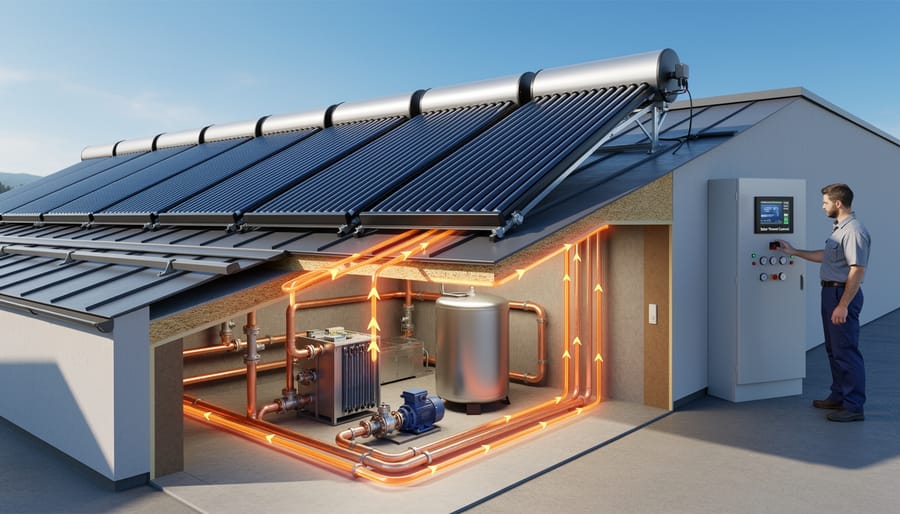
The simplest method is the insulated water tank. Most domestic systems heat water during the day and hold it for evening showers or the next morning. A well-insulated tank can lose surprisingly little heat overnight, and water’s high specific heat means a modest volume holds a lot of energy. Larger installations, such as district heating networks, use seasonal pit or tank storage to carry summer heat into winter.
Phase-change materials take a different approach. As they melt, they absorb large amounts of heat at a nearly constant temperature, then release it as they solidify. This packs more energy into a smaller space than water alone and delivers heat at a steady, predictable temperature, which suits certain building and process applications.
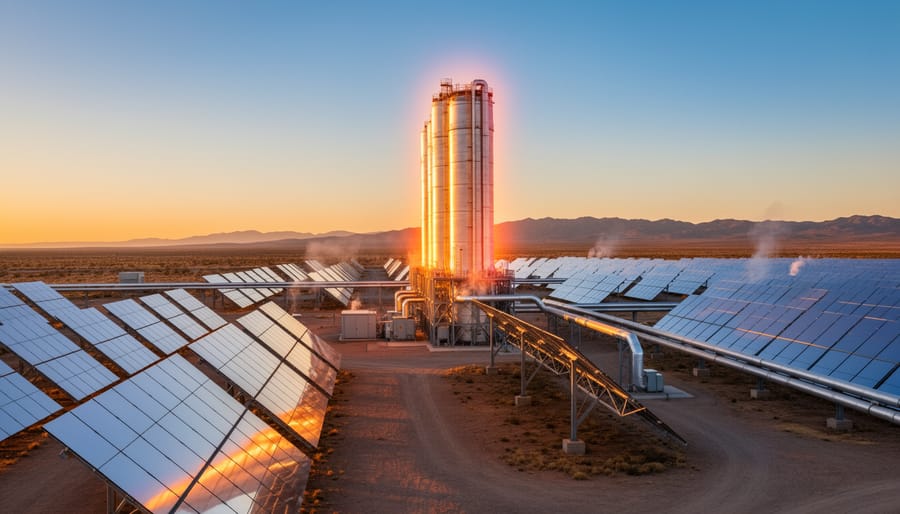
At utility scale, concentrating solar power plants typically store heat in molten salt, usually a mix of sodium and potassium nitrates. Hot salt is held in insulated tanks and later used to raise steam for a turbine, allowing a plant to generate electricity for hours after dark or through passing clouds.
In each case, storing heat is generally far cheaper than storing electricity, which is a key reason solar thermal remains attractive for dispatchable power and round-the-clock heating.
Types of Solar Thermal Collectors and Technologies
Low-Temperature Collectors: Flat-Plate, Evacuated-Tube and Unglazed Systems
Low-temperature collectors do the quiet, everyday work of solar thermal, heating water to roughly 30 to 100°C with no mirrors or tracking. Each type is simply a dark absorber that turns sunlight into heat and passes it to a circulating fluid. What separates them is how well they hold that heat once they have it.
- Unglazed collectors: simple black polymer or metal absorbers with no cover, best suited to swimming pool heating in warm climates.
- Flat-plate collectors: an insulated box with a glass cover and selective-coated absorber, the standard choice for domestic hot water across the Mediterranean and much of Europe.
- Evacuated-tube collectors: rows of vacuum-sealed glass tubes that nearly eliminate convective heat loss, widely deployed in China and favoured in colder or cloudier regions.
Climate drives the choice more than anything else. In warm, sunny regions, where the gap between the absorber and the outside air is small, a flat-plate or even an unglazed collector delivers excellent value. As ambient temperatures fall, losses from the absorber rise sharply. The vacuum in an evacuated tube works like a thermos flask, so these collectors keep performing in winter and in diffuse light, though they cost more and need more care if a tube breaks.
Fluid choice follows the same logic. Water suits frost-free sites, while a glycol mix protects closed-loop systems where freezing is possible. Careful sizing and a sound plan for solar hot water installation matter as much as the collector itself, since tilt, orientation, shading and pipe insulation all affect how much heat actually reaches the tank. Matching the collector to the climate and the load is what makes these systems pay back.
Concentrating Solar Power and High-Temperature Systems
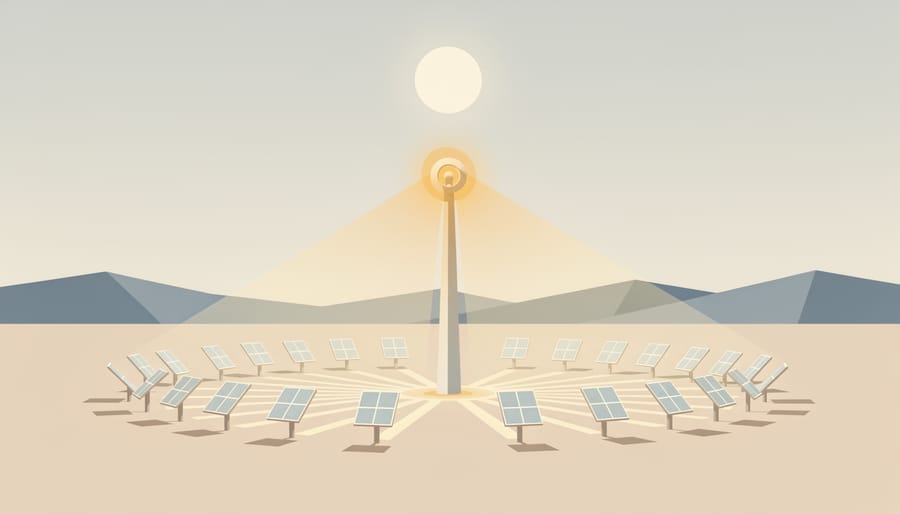
Concentrating solar power, or CSP, uses mirrors to focus direct sunlight onto a small receiver, pushing temperatures far beyond what a flat collector can reach. Because it depends on direct beam radiation, CSP works best in clear, arid regions such as Spain, North Africa, the Middle East and the southwestern United States.
Four main designs share this principle, differing in how they aim the light:
– Parabolic troughs use long, curved mirrors that track the sun along one axis and focus light onto a tube running along the mirror’s focal line. A heat transfer fluid, usually synthetic oil, circulates through the tube. Troughs are the most widely deployed CSP design.
– Linear Fresnel reflectors approximate the same effect with rows of nearly flat mirror strips set close to the ground, directing light onto a fixed elevated receiver. The simpler structure can lower cost, though optical efficiency is typically lower.
– Solar power towers surround a central receiver with a field of tracking mirrors called heliostats. Concentrating light on a single point allows the highest temperatures of the group, which supports more efficient power cycles.
– Parabolic dishes track the sun in two axes and focus light onto a receiver at the dish’s focal point, often paired with a Stirling engine. They are modular but less common at utility scale.
In a plant, the concentrated heat warms the working fluid, which passes through a heat exchanger to boil water into high-pressure steam. That steam drives a turbine and generator, much as in a conventional thermal power station. For a closer look at the process, see how CSP generates steam.
The key advantage is storage. Without it, a plant produces power only while the sun shines. With molten salt tanks, surplus heat can be held for hours and converted to electricity after dark, giving the plant dispatchable output.
How Solar Thermal Energy Is Used: Homes, Industry and Power Generation
Water Heating, Space Heating and District Heating
The most familiar use of solar heat is domestic hot water. A typical system pairs rooftop collectors with an insulated storage tank. In sunnier markets such as China, Israel, Turkey and Cyprus, simple thermosiphon units, where hot water rises naturally from the collector to a tank mounted above it, sit on millions of roofs. In cooler climates, pumped systems with a heat exchanger and antifreeze fluid are the norm, usually backed up by a gas or electric element for cloudy stretches.
Solar combisystems stretch the same idea further. They feed both hot water and space heating, often through low-temperature underfloor circuits that work well with modest collector temperatures. The catch is seasonal: output peaks in summer, when heating demand is lowest, so these systems are sized carefully to avoid overheating.
Swimming pool heating is the easiest application. Unglazed polymer collectors suffice because the water only needs warming a few degrees, and the pool itself acts as storage.
At the largest scale, collector fields covering several football pitches feed district heating networks. Denmark leads here, with towns such as Vojens and Silkeborg pairing big arrays with seasonal storage in water pits, while Germany, Austria and China are expanding similar plants. Where networks already exist, solar heat slots in readily and cuts fuel use.
Industrial Process Heat, Desalination and Solar Cooling
Much of the heat industry buys is low to medium temperature, which is exactly where solar collectors perform well. Food and beverage plants use hot water and steam for washing, pasteurising and cooking. Textile mills need heat for dyeing and finishing, and mining operations use it to leach and process metals, while chemical plants rely on it for many of their preheating and drying steps. Flat-plate, evacuated-tube and parabolic trough collectors can supply a large share of these loads, and they typically feed the existing steam or hot-water network as a preheating stage rather than replacing the boiler outright. Because process heat is still largely supplied by burning fossil fuels, it is widely seen as one of the largest decarbonization opportunities in the energy system. For businesses weighing the capital cost, corporate solar funding can shape how quickly these projects reach a viable payback.
The same heat can do other useful work. In thermal desalination, solar-heated water or steam drives multi-effect distillation or multi-stage flash units, which suits arid coastal regions with strong sunshine and scarce freshwater. Solar cooling works differently again: absorption chillers use hot water to drive a refrigeration cycle instead of an electric compressor. That means cooling demand, which peaks when the sun is strongest, can be met directly from solar heat.
Concentrating Solar Power for Dispatchable Electricity
Concentrating solar power turns high-temperature solar heat into electricity through a conventional steam cycle. Mirrors focus sunlight onto a receiver, the heat raises steam, and a turbine drives a generator, much as in a gas or coal plant, but with the sun as the fuel. The real advantage is storage. Plants that pair the solar field with insulated molten salt tanks can bank heat during the day and run the turbine into the evening or overnight, delivering power when demand peaks and photovoltaic output has faded.
That makes CSP a natural partner to photovoltaics rather than a rival. Photovoltaic plants supply cheap daytime electricity, while thermal storage offers firm, schedulable capacity that can stabilize the grid with the rotating inertia of a turbine. Some operators now build hybrid sites that combine both, using photovoltaic output for daytime demand and routing surplus into heat storage.
Deployment follows the sun and the policy. CSP is concentrated in regions with strong direct sunlight, including Spain, North Africa, the Middle East, South Africa, Chile, China and the southwestern United States. Cross-border financing and technology transfer matter here, and the growth of global solar partnerships is helping bring these capital-intensive projects to sunnier markets.
Strengths, Limits and Common Questions About Solar Thermal Energy
Solar thermal’s biggest strength is how directly it works. Absorbing sunlight and turning it into heat involves few conversion steps, so well-designed collectors capture a large share of incoming energy as usable heat. Storage is the other advantage. A insulated water tank or a molten salt reservoir holds heat far more cheaply than batteries hold electricity, and operating costs stay low because the systems have few moving parts, mainly pumps and controls. Even a simple project, such as a homemade solar hot water heater, shows how modest the hardware can be.
The constraints are just as real. Output depends on local sunlight, and concentrating systems need strong direct sun. Heat is also harder to move than electricity, so long pipe runs lose energy and the system works best close to where the heat is used. Meanwhile, falling photovoltaic and heat pump costs give buyers strong alternatives, particularly for space heating and in places with modest solar resources.
Is solar thermal the same as solar PV?
No. Solar thermal captures the sun’s heat for hot water, heating, process heat or steam, while photovoltaics convert sunlight directly into electricity.
Does solar thermal work in cold or cloudy climates?
Yes, within limits. Collectors respond to sunlight rather than outdoor temperature, and evacuated-tube designs insulate well against cold, but cloudy weather reduces output and often calls for a backup heat source.
What temperatures can solar thermal reach?
It depends on the technology. Unglazed and flat-plate collectors serve low-temperature needs, while concentrating systems with mirrors can reach the high temperatures needed to generate steam for turbines.
Can solar thermal and photovoltaics be used together?
Yes. Many projects pair them, using photovoltaics for electricity and solar thermal for heat or dispatchable power, and some hybrid collectors produce both from the same area.
Pairing the technologies often makes the most sense, with each one handling the job it does best.
Solar thermal energy does one thing well: it turns sunlight directly into heat, and heat is what most of the world’s energy demand actually asks for. Whether that heat warms a household water tank, feeds a district network, runs a food-processing line or drives steam turbines at a utility-scale plant, the physics is the same. A surface absorbs radiation, a fluid carries the heat away, and the system delivers it where it is needed or stores it for later.
That distinction is why Thermal Applications of Solar Energy deserve more attention than they often receive. Photovoltaics have rightly captured headlines for cheap electricity, but electrifying every heating task is neither always practical nor always efficient. Where a process simply needs hot water, hot air or steam, a collector field can supply it with few conversion steps and a modest operating cost. The match is strongest where sunshine is plentiful, where demand for heat is steady, and where the alternative is burning gas, oil or coal.
Looking ahead, two areas will likely shape how much of that potential is realized. The first is thermal storage. Hot water tanks, phase-change materials and molten salt let a plant or building keep using the sun’s heat after dark, which makes solar thermal a flexible partner to variable renewables on modern grids. The second is industrial heat, a large and stubborn source of emissions that few other clean technologies address as directly. Progress on both will help decide how quickly heat, long treated as an afterthought, becomes a central part of the global energy transition.